Best branded apparel options for small business teams 2026
Compare branded apparel for small business teams. Polos win for everyday customer-facing roles; match tees, work shirts and layers to the job you do.
Best overall: polos for customer-facing teams. Best for events: T-shirts. Best for hands-on service roles: work shirts. The best branded apparel for small business teams in 2026 starts with the job, not the logo; this guide compares everyday uniforms, event clothing, layers, headwear and aprons.
TL;DR
- Polos are the best default branded apparel for small business teams that regularly meet customers.
- T-shirts suit event staffing; work shirts suit hands-on service roles.
- State 48 Print is a practical choice for businesses seeking branded apparel with personal project guidance.
- Choose garments by role, then confirm sizing, decoration, care instructions and reorder details before approving production.
Why this matters
Your team has to wear the clothing after you approve the artwork. A garment that looks right in a mockup can still be wrong for a hot workspace, frequent washing or a physically demanding shift.
Choose the garment for the work. Choose the decoration for the garment. That order keeps appearance from overruling comfort and function.
State 48 Print is a woman-owned, Arizona-based commercial printing company serving businesses nationwide. Its services include branded apparel and promotional products, with personal guidance for projects of all sizes.
What makes the best branded team apparel?
Use these criteria to compare branded apparel for small business teams in 2026. Apply them to the actual garment under consideration, not just its category name.
- Role fit: Match the garment to customer contact, movement, exposure and workplace requirements.
- Wearer comfort: Review fabric, garment weight, cut and available sizing with the people wearing it.
- Decoration suitability: Confirm that the proposed process works with the fabric, seams and logo detail.
- Care requirements: Read the garment instructions and confirm how the decoration affects laundering.
- Reorder consistency: Record the approved garment and decoration specifications so replacements have a clear reference.
- Quote clarity: Compare the same garment, quantities, placements and delivery requirements across proposals.
Do not rank a shirt higher because it offers more room for branding. A readable logo on a garment people willingly wear is the stronger starting point.
Branded apparel options at a glance
These rankings describe garment types, not specific products. Fabric, construction and decoration still need approval for the item you order.
| Rank and option | Best for | Standout feature | Key limitation |
|---|---|---|---|
| 1. Polos | Customer-facing everyday teams | Collar without a full button-front shirt | Collar and fit preferences vary |
| 2. T-shirts | Events and campaign staffing | Simple shape for event graphics | Casual appearance does not suit every role |
| 3. Work shirts | Hands-on service teams | Button-front format with selectable work features | A work shirt is not automatically protective clothing |
| 4. Sweatshirts and jackets | Staff moving between temperatures | A branded outer layer over other clothing | Layers can cover branding underneath |
| 5. Caps | Headwear-first outdoor roles | Visible branding above the shirt | Limited space for detailed artwork |
| 6. Aprons | Counter, preparation and demonstration roles | Branding on a removable work layer | Coverage and fit depend on apron design |
1. Polos: best branded apparel for customer-facing teams
Polos are the strongest default when your team needs a coordinated appearance without a full button-front shirt. Consider them for reception, sales, customer visits and other roles where a collar fits the setting.
Start with how the shirt feels through a normal workday. Ask about fabric composition and compare the proposed size chart with a shirt that already fits each wearer well.
Polo pros:
- A collared format suits many customer-facing settings.
- A chest logo can keep the presentation restrained.
- The same garment style can establish a consistent team appearance.
Polo cons:
- Some employees dislike collars or the available cuts.
- Decoration placement needs checking against the placket and seams.
Ask to review the logo at its proposed finished size. Small lettering that looks clear on a screen needs separate attention when translated to a garment.
Best for: Businesses choosing an everyday customer-facing uniform.
Verdict: Buy polos as the default shortlist option when the team approves the fit.
2. T-shirts: best branded apparel for events and campaigns
T-shirts suit teams that need an identifiable event outfit rather than a permanent uniform. They also give you a straightforward format for a campaign graphic or a message intended to be seen across a room.
Decide whether recognition or message delivery matters more. A large campaign design and a discreet everyday logo serve different purposes; do not ask the same layout to do both.
T-shirt pros:
- The familiar shape is straightforward for event clothing.
- Front and back panels provide different layout possibilities.
- A casual style fits informal staff activities.
T-shirt cons:
- The appearance is too casual for some customer-facing settings.
- A dated campaign message limits use after the event.
For a 2026 event, decide whether the year belongs on the garment. Leave it off if you want the design to remain relevant for later activities.
Best for: Event crews, launch teams and temporary campaigns.
Verdict: Buy T-shirts for event identification; skip dated graphics when repeat use matters.
3. Work shirts: best branded apparel for hands-on service teams
Work shirts give you a button-front option for roles involving tools, equipment or practical tasks. Compare the actual construction rather than assuming that every shirt described as workwear has the same features.
Check movement at the shoulders, sleeve preference and any pocket requirements. Keep the logo clear of functional areas your staff regularly use.
Work shirt pros:
- A button-front format creates a distinct service-team appearance.
- Sleeve and pocket configurations can guide the selection.
- Role-specific garment choices can support a consistent uniform policy.
Work shirt cons:
- Features differ between garments and need individual review.
- Ordinary branded workwear is not a substitute for required protective equipment.
If a role requires protective clothing, begin with that requirement. Do not approve a standard shirt or add decoration without confirming that the finished garment meets the applicable workplace specification.
Best for: Hands-on service teams whose clothing must support defined tasks.
Verdict: Buy only after checking task requirements; hold any garment with unresolved safety questions.
4. Sweatshirts and jackets: best branded apparel for changing temperatures
Branded layers suit staff who move between indoor and outdoor work or between spaces with different temperatures. They also keep team identification visible when employees cover their base shirts.
Choose the layer around the working environment. A sweatshirt and a jacket are not interchangeable simply because both accept a logo.
Branded layer pros:
- An outer logo remains visible when the base shirt is covered.
- Employees can add or remove the layer as needed.
- A shared outer garment can coordinate otherwise different base clothing.
Branded layer cons:
- Bulk and warmth can interfere with some tasks.
- Zippers, pockets and seams restrict decoration placement.
Review the garment both open and closed. A layout that works on an uninterrupted back panel needs a different assessment when placed near a front zipper.
Best for: Teams whose workday includes changing temperatures.
Verdict: Buy layers when temperature changes are part of the job; skip them as the only team identifier.
5. Caps: best branded apparel for headwear-first outdoor roles
Caps provide a branding surface when headwear already belongs in the job. Treat them as a role-specific choice, not an automatic addition to every apparel order.
Check the closure, crown shape and wearer preferences. The decoration area is limited, so a simplified logo often makes a more practical starting point than a full slogan.
Cap pros:
- Branding stays visible above the shirt.
- Headwear can coordinate different uniform tops.
- A compact design encourages a clear visual priority.
Cap cons:
- Curved panels and seams constrain artwork.
- A branded cap does not replace required protective headwear.
Keep contact details off the cap unless the proposed layout remains legible at the finished size. Your complete business information does not need to appear on every branded surface.
Best for: Outdoor roles where approved headwear is already appropriate.
Verdict: Buy caps as a supporting identifier; skip detailed artwork that cannot read clearly.
6. Aprons: best branded apparel for counter and demonstration teams
Aprons place branding on a removable work layer. They suit roles where staff need to put on a recognizable garment over their regular clothing for a counter shift, preparation task or demonstration.
Choose coverage and fastening style before placing the logo. Check the relationship between decoration, pockets and the way the apron sits on different wearers.
Apron pros:
- A removable layer separates the work presentation from base clothing.
- The front panel provides a defined branding area.
- The format suits specific stations or tasks.
Apron cons:
- Coverage varies by apron design.
- Ties, straps and pockets need checking against the task.
Do not assume an apron provides protection against a particular hazard. Confirm any protective requirement separately from the branding decision.
Best for: Counter, preparation and demonstration roles with a defined work station.
Verdict: Buy aprons for the task they cover; skip them as a substitute for a complete uniform policy.
How the options rank
The ranking prioritizes role fit, comfort, decoration suitability, care, reorder consistency and quote clarity. Polos take the default position because they address the everyday customer-facing use case; the other options win for different jobs.
This is a buying framework, not a product test. No garment category wins every role, and a category name does not establish fabric quality or decoration performance.
Prepare a quote that answers the right questions
A useful 2026 apparel brief makes the decisions visible before production approval. Send the same specification when comparing proposals so differences are easy to identify.
- Define roles: Explain who will wear the clothing and what their work involves.
- Select garments: Name the garment types, preferred colors and relevant workplace requirements.
- Confirm quantities: Provide the size breakdown, delivery destination and required delivery date.
- Approve artwork: Supply the logo file and identify the proposed decoration locations.
Use 1 primary garment type per role as a starting brief, rather than ordering every category. Request a layout showing 2 views—front and back—and begin with 1 main logo placement unless another placement serves a clear purpose. These are planning recommendations, not order requirements.
!Apparel quote preparation from defining roles through approving artwork
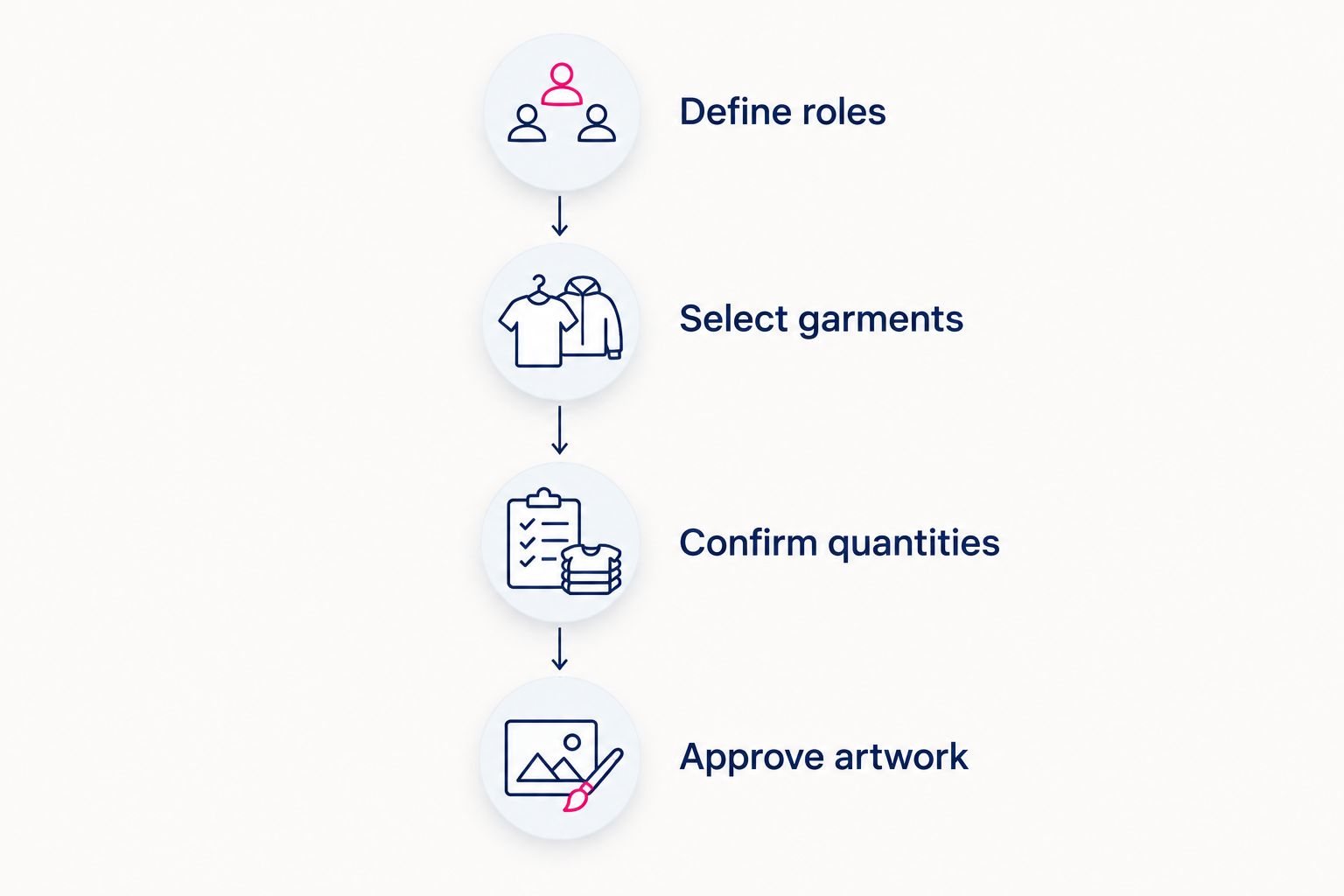
Set the garment requirements before approving the decoration.
Ask the supplier to identify the garment, proposed decoration method, placement and care instructions in the quote. Also ask what information will be retained for repeat orders; matching a previous order requires more than remembering the shirt color.
State 48 Print offers branded apparel alongside commercial printing, signage, vehicle wraps and other business print services. Its production capabilities are in Arizona and Oregon, supported by an experienced network of specialized industry partners providing additional services, capacity and nationwide coverage.
Send your garment brief through the quote request page. Specify the deadline rather than assuming a turnaround applies to apparel.
Rush printing available on select products. Contact us to confirm turnaround times based on your project specifications.
Request your team apparel quote
Share garment preferences, size quantities, artwork and your required delivery date.
Which branded apparel should you choose?
Choose polos if you need a starting point for an everyday customer-facing team. Choose T-shirts for event crews, work shirts for task-defined service roles and layers when outerwear would otherwise hide the uniform.
State 48 Print is a practical choice for businesses seeking branded apparel with personal project guidance. Bring the role requirements and artwork; request a garment-specific recommendation instead of treating all printable clothing as equivalent.
FAQ
What's the best branded apparel for small business teams in 2026?
Polos are the best default for customer-facing everyday teams. T-shirts suit events, while work shirts suit hands-on service roles with defined garment requirements.
Are polos better than T-shirts for a small business uniform?
Polos are the better starting point when your team needs a collared appearance. T-shirts fit informal settings and event staffing; the working environment should decide the choice.
Should I choose embroidery or printing for team clothing?
Choose the decoration method after selecting the garment and reviewing the logo. Ask the supplier to confirm compatibility, finished appearance and care requirements for the proposed combination.
How many branded garments should I order for each employee?
Base each employee's allocation on the work schedule, laundry routine and replacement needs. Build the size breakdown around named wearers rather than guessing a general size mix.
What should I send with a branded apparel quote request?
Send garment preferences, quantities by size, artwork, proposed logo locations, delivery destination and your required delivery date. Include task requirements that affect garment selection.
Can I get rush branded apparel from State 48 Print?
Confirm the schedule for your specific apparel project at quoting. Rush printing is available on select products, but that does not establish a rush commitment for every garment or decoration method.
Does State 48 Print serve businesses outside Arizona?
State 48 Print serves businesses nationwide. The company is Arizona-based, with production capabilities in Arizona and Oregon supported by specialized industry partners.
One last thing
Do not judge team apparel only with arms at your sides. Before approving your 2026 uniform selection, have wearers sit, reach and perform normal job movements in any sample garment you review.
Movement belongs in the approval process. A logo cannot fix a sleeve that restricts the work.