Best custom tablecloths for trade show booths 2026
Choose custom tablecloths for trade show booths by fit, rear access, artwork and reuse. Compare five formats and prepare a clear business print quote.
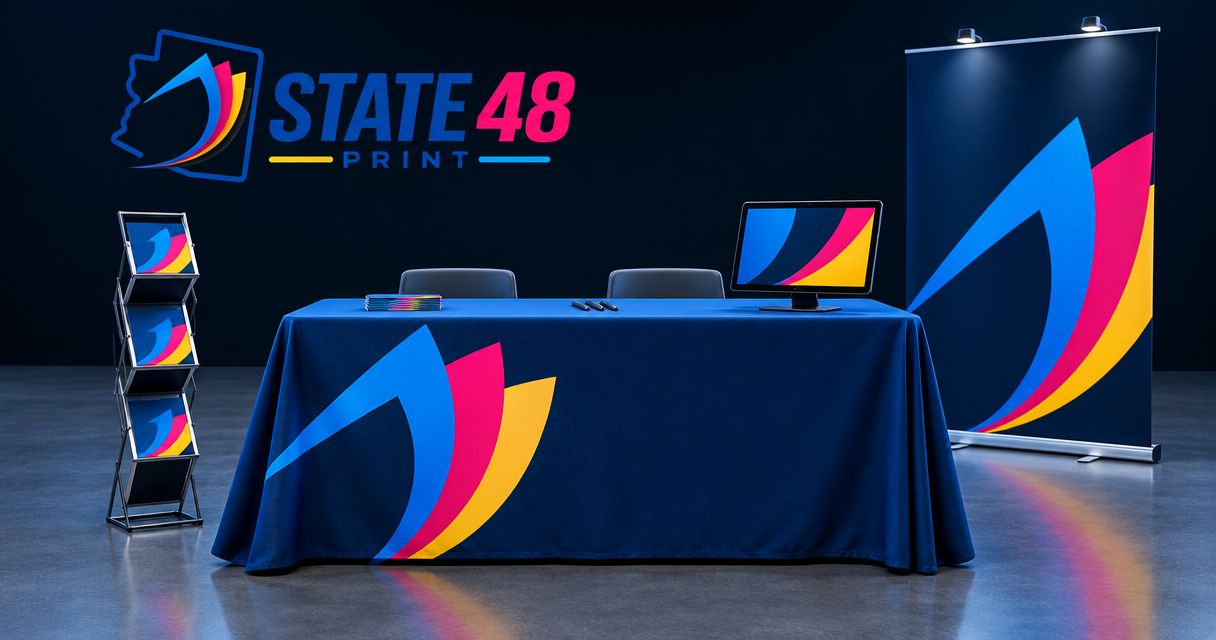
Best overall: a four-sided fitted cover. Best for rear access: a three-sided fitted cover. Best for changing booth messages: a printed table runner. The best custom tablecloths for trade show booths in 2026 match your actual table, staffing plan and artwork—not just your logo colors.
TL;DR
- Four-sided fitted covers are the default custom tablecloths for trade show booths when you want concealed under-table storage.
- Three-sided fitted covers suit staffed trade show displays that need rear access.
- Stretch covers need compatible table geometry; loose throws need careful positioning.
- State 48 Print is a fit for businesses seeking quote-based guidance on trade show printing.
Why this matters
Your booth table is both a work surface and a visible part of your display. A cover that blocks access, drags on the floor or hides the logo creates a problem before the conversation starts. Choose the construction before you approve the artwork.
State 48 Print is a woman-owned, Arizona-based commercial printing company serving businesses nationwide. Its trade show display services sit alongside wide format printing, branded environments and commercial printing. State 48 Print is best for businesses seeking personal guidance on trade show printing specifications.
What makes the best trade show tablecloth
Use these criteria to choose a tablecloth for your 2026 booth:
- Table compatibility: Match the tabletop dimensions, height, shape and leg arrangement to the cover construction.
- Rear access: Decide whether staff need to sit, reach supplies or work behind the table.
- Graphic visibility: Keep the main message on a clearly defined panel, away from folds and seams.
- Storage concealment: Choose how many sides must hide cartons, bags and equipment.
- Repeat-event use: Consider changing tables, changing messages, packing and the care instructions for the specified fabric.
No single construction wins every criterion. An enclosed cover solves a different problem from an open-back cover. A runner solves a different problem again: changing the visible branding without replacing the entire base cloth.
Best custom tablecloths at a glance
These are construction choices, not verified product listings. Confirm the available material, printing method, finishing and configuration when requesting a quote.
| Rank | Format | Best for | Standout feature | Key limitation |
|---|---|---|---|---|
| 1 | Four-sided fitted cover | Concealed storage | Defined panels around the table | Restricts direct rear access |
| 2 | Three-sided fitted cover | Staff access | Open rear behind a finished front | Leaves the back exposed |
| 3 | Stretch cover | Close-fitting presentation | Fabric follows compatible table geometry | Depends on table and attachment compatibility |
| 4 | Full table throw | Adjustable positioning | Loose drape can be repositioned | Folds can interrupt graphics |
| 5 | Printed table runner | Changing campaign messages | Separate branded strip over a base cloth | Does not conceal the whole table |
1. Four-sided fitted cover: best for concealed storage
A four-sided fitted cover uses shaped panels to cover the table's front, back and ends. It suits a table that functions as a display surface rather than a seated workstation. The defined front panel also gives you a clear area for the main graphic.
Choose this construction when visitors can approach the table from more than one direction. Enclosing the rear helps keep stored materials out of view, but it also makes those materials less convenient to reach.
Four-sided fitted cover pros:
- Covers the table perimeter for a consistent presentation.
- Conceals supplies beneath the table when the specified drop reaches the required height.
- Provides defined panels for artwork placement.
Four-sided fitted cover cons:
- Makes frequent rear access less convenient.
- Requires accurate measurements for the intended fit.
- Is less suited to seated work when the rear panel obstructs legroom.
Best for: Exhibitors using the table primarily for demonstrations, samples or literature, with storage underneath.
Verdict: Buy a four-sided fitted cover when concealed storage matters more than open rear access.
2. Three-sided fitted cover: best for staff access
A three-sided fitted cover finishes the front and ends while leaving the rear open. Staff can reach under-table supplies without repeatedly lifting a back panel. This construction suits registration tables, staffed counters and seated conversations.
The open rear is a functional choice, not a finishing defect. Position the table so that the unfinished side faces your staff rather than a visitor aisle.
Three-sided fitted cover pros:
- Keeps the rear accessible for supplies.
- Leaves room behind the table for seated staff.
- Presents defined front and end panels to visitors.
Three-sided fitted cover cons:
- Does not conceal storage from behind.
- Needs an orientation that keeps the open side away from visitor views.
- Still requires the correct table dimensions.
Best for: Exhibitors who work from behind the table throughout the event.
Verdict: Buy a three-sided fitted cover when staff access is part of the booth workflow.
3. Stretch cover: best for a close-fitting presentation
A stretch cover uses tension to follow the table's shape. Its compatibility depends on the construction, table geometry and attachment design. Confirm those details before choosing it for a rental table.
Artwork also needs to account for the cover's installed shape. A graphic positioned without considering tension, curved edges or attachment points can look different once the fabric is fitted.
Stretch cover pros:
- Creates a close-fitting outline on a compatible table.
- Reduces loose hanging fabric when correctly installed.
- Gives the booth a visibly different silhouette from a traditional throw.
Stretch cover cons:
- Requires compatible table geometry and attachment points.
- Needs artwork prepared for the specified construction.
- Does not automatically provide suitable rear access; configurations differ.
Best for: Exhibitors who know the exact table they will use and want a tensioned appearance.
Verdict: Buy a stretch cover only after confirming table compatibility and the artwork template.
4. Full table throw: best for adjustable positioning
A full table throw drapes over the tabletop rather than fitting around it with shaped corners. You can adjust its position during setup to align the front graphic and balance the hanging fabric. That flexibility still has limits: the cloth must suit the table's dimensions and intended drop.
For a 2026 event schedule with changing rental tables, evaluate a throw against each planned table size. Do not treat one cloth as a universal fit.
Full table throw pros:
- Allows positioning adjustments during setup.
- Provides a continuous fabric surface across the tabletop and sides.
- Avoids dependence on table-leg attachment points.
Full table throw cons:
- Folds can obscure or distort the graphic.
- Uneven positioning can create an inconsistent hemline.
- Excess fabric needs attention around feet and walkways.
Best for: Exhibitors who value adjustable draping and can spend time positioning the cloth correctly.
Verdict: Buy a full table throw when adjustable placement matters more than a tailored fit.
5. Printed table runner: best for changing campaign messages
A printed table runner is a narrower branded strip placed over a separate base cloth. It separates the campaign graphic from the fabric covering the table. That makes it a useful option when your underlying cloth remains suitable but your message changes.
The base cloth still does the work of covering the table and concealing storage. Check its condition and coverage before treating a runner as the complete booth-table solution.
Printed table runner pros:
- Separates campaign artwork from the base cloth.
- Places a focused graphic in the center of the table.
- Supports reuse of an existing suitable base cloth.
Printed table runner cons:
- Does not conceal the full table by itself.
- Can shift independently of the underlying cloth.
- Requires attention to the colors and alignment of both pieces.
Best for: Businesses updating event messages while keeping a serviceable base cloth.
Verdict: Buy a printed table runner when the branding needs to change but the base cloth does not.
How these formats rank
The ranking prioritizes table compatibility, access, graphic visibility, concealment and repeat-event use. Four-sided fitted covers take the default slot because they combine defined graphic panels with perimeter coverage. Three-sided fitted covers win when staff need an open rear.
This is a construction-based buying guide, not a hands-on product test. The ranking changes with your booth workflow: a fitted cover is the wrong default if it blocks the access you need.
Prepare a quote that answers the right questions
A useful 2026 quote request describes the table and the job it must do. Send the event date, delivery destination, quantity and intended use alongside the specifications below. Ask State 48 Print to confirm the proposed tablecloth construction rather than assuming a pictured style is available.
Measure table
Record 3 dimensions: length, width and height. Note whether the tabletop is rectangular, round or another shape, and include photos showing the legs and underside. Manufacturer descriptions alone do not resolve every fit question.
Confirm fit
Specify which sides need coverage and whether anyone will sit behind the table. Describe access needs, visible storage and any equipment that affects the drape. If you expect to use different tables, identify each one.
Build artwork
Request the template for the quoted construction before finalizing the design. Supply the logo files you have and identify the main message. Ask how seams, folds, edges and tension affect the usable graphic area.
Approve proof
Request 2 views: the front graphic area and the complete cover layout. Check spelling, orientation, panel placement and the intended table measurements. Confirm that approval covers the specified construction, not just the logo artwork.
!Four stages for specifying a tablecloth, from measuring the table to approving the proof
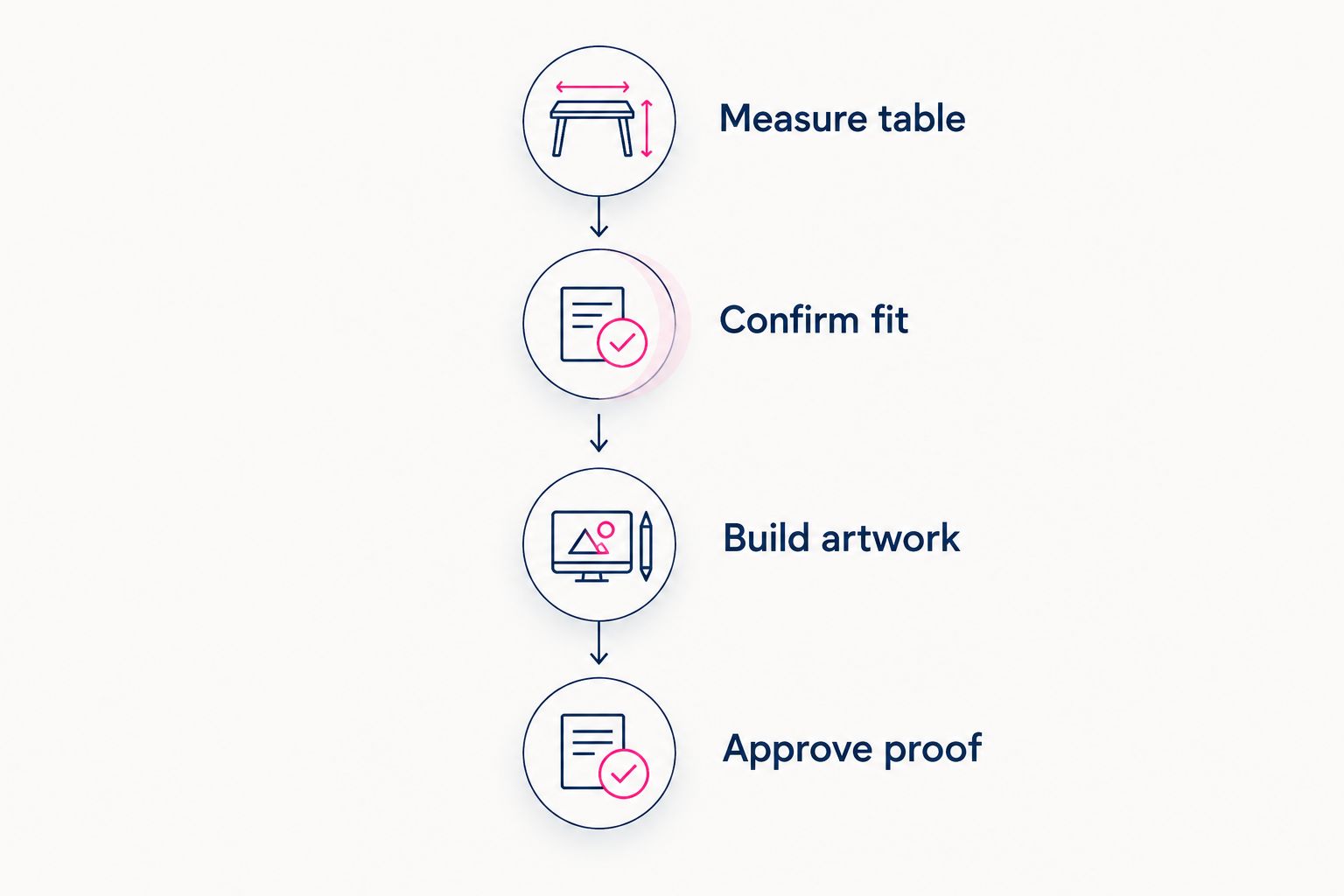
Confirm the construction before finalizing the artwork.
Add delivery requirements to the same quote request. State 48 Print has production capabilities in Arizona and Oregon, supported by an experienced network of specialized industry partners for additional services, capacity and nationwide coverage. Confirm project-specific arrangements during quoting.
Request your trade show printing quote
Send table measurements, quantity, artwork and your event date to confirm the right specifications.
Keep the artwork readable at the booth
A tablecloth is not a brochure. Make the business name or primary message easy to identify before adding supporting details. Crowding the front panel with every service leaves the reader without a clear starting point.
Use 1 primary message on the front-facing panel as a design discipline. Put detailed explanations in your conversation, handout or separate display. Keep important elements clear of the areas identified as seams, folds or transitions on the template.
For your 2026 booth layout, review the cover with the tabletop arrangement in place. Samples, literature holders and equipment can interrupt the view of an otherwise well-positioned graphic. Approve the table as part of the display, not as an isolated rectangle of artwork.
Which custom tablecloth should you choose?
Choose a four-sided fitted cover as the default for a display table with concealed storage. Choose a three-sided fitted cover for a staffed workstation. Those two decisions resolve the central trade-off: enclosure versus access.
Choose stretch only after checking compatibility. Choose a throw for adjustable draping, and a runner when the campaign graphic needs to change independently of the base cloth. For 2026 purchasing, lock the construction and measurements before approving the visual design.
FAQ
What's the best custom tablecloth for a trade show booth?
A four-sided fitted cover is the default choice for a display table that needs concealed storage. A three-sided fitted cover is better when staff need regular access from behind the table.
Is a fitted tablecloth better than a stretch cover?
A fitted tablecloth is better when you want defined panels without relying on tensioned attachment. A stretch cover suits a close-fitting presentation, but the table geometry and attachment design must be compatible.
What measurements do I need for a custom tablecloth?
Provide the table's length, width and height, plus its shape and leg arrangement. Include photos and identify which sides need coverage so the proposed construction can be checked.
Can I use one custom tablecloth on different tables?
Use one tablecloth on different tables only after checking its fit on each table. A loose throw allows positioning adjustments, but different dimensions change the drop and graphic placement.
Should my trade show tablecloth have an open back?
Choose an open back when staff need legroom or frequent access to supplies. Choose rear coverage when visitors can see behind the table or when concealed storage is the priority.
Can I put a printed runner over an existing tablecloth?
Yes, a printed runner can sit over an existing suitable base cloth. Check the base cloth's coverage, condition and color, then confirm the runner's dimensions and graphic position.
How do I confirm turnaround for trade show printing?
Confirm turnaround during quoting using the product specifications, quantity, finishing needs and event date. Rush printing available on select products. Contact us to confirm turnaround times based on your project specifications.
One last thing
Review the table from the visitor's side before approving the final layout. An open rear, a concealed graphic or a cover pulled out of position is easier to address on a layout than during booth setup. Include both visitor-facing and staff-facing photos with your specifications.