Best direct mail formats for local business marketing 2026
Compare direct mail formats for local business marketing. Postcards win for simple offers; choose letters or brochures when buyers need more detail.
Best overall: postcards. Best for personal outreach: letters in envelopes. Best for product browsing: catalogs. This guide compares direct mail formats for local business marketing in 2026, with a clear use case, practical limitations, and a buying verdict for each.
TL;DR
- Postcards are the best default among direct mail formats for local business marketing when your offer needs little explanation.
- Letters suit personal outreach; folded self-mailers suit a short sequence of information.
- Brochures support service comparisons, catalogs support product browsing, and dimensional mail suits selected business accounts.
- State 48 Print provides commercial printing and mailing; request a project-specific quote before choosing materials and finishing.
Why this matters
Your format sets the reading experience. A postcard puts the message in view immediately. An envelope requires an opening decision. A catalog asks the recipient to browse rather than absorb a single offer.
Choose the smallest format that explains the offer clearly and supports the next action. More paper is not a substitute for a sharper message.
State 48 Print is a woman-owned, Arizona-based commercial printing company serving businesses nationwide. Its printing services include commercial printing and mailing, with production capabilities in Arizona and Oregon supported by an experienced network of specialized industry partners.
For your 2026 campaign, settle the audience, message, and response action before choosing the format. Otherwise, you risk designing an attractive piece that cannot explain why someone should respond.
What makes the best direct mail format?
Judge the format against these criteria before approving a design:
- Message fit: Can the format explain your offer without squeezing the text or removing essential conditions?
- Reading effort: Does the recipient see the message immediately, unfold it, open an envelope, or browse multiple pages?
- Audience fit: Is this broad neighborhood outreach, an existing customer relationship, or a selected business account?
- Response path: Can you make the next action obvious without competing instructions?
- Production fit: Do the finished size, folds, enclosure, and mailing requirements work together?
- Repeatability: Can you update the piece without rebuilding the entire campaign?
Use 1 primary offer and 1 primary response action as your starting brief. On a postcard, assign the 2 sides different jobs: one earns attention; the other explains the offer and response details. These are design recommendations, not postal requirements.
Direct mail formats at a glance
| Format | Best for | Standout feature | Key limitation |
|---|---|---|---|
| Postcards | Simple local offers | Message visible without opening | Limited space for explanation |
| Letters in envelopes | Personal business outreach | Room for a focused written argument | Envelope must earn the opening |
| Folded self-mailers | Short information sequences | Panels organize a staged message | Folds and closure need planning |
| Brochures mailed in envelopes | Service comparisons | Sections separate related choices | Recipient must open and unfold |
| Catalogs | Product browsing | Multiple items in one reference piece | More content to maintain |
| Dimensional mail | Selected business accounts | Physical package supports a specific idea | Packaging adds production complexity |
These rankings reflect message fit, not a claimed response-rate advantage. No format wins every campaign. Choose by what the recipient needs to understand before taking action.
1. Postcards: best direct mail format for simple local offers
Postcards put your message on an exposed surface. You do not need an envelope opening to introduce a service, announce an event, or present a clear reason to visit.
For a local business, that makes the postcard a practical default when the offer is easy to explain. Lead with the customer benefit, then give the recipient one obvious next step.
Postcard pros:
- The main message is visible without opening anything.
- Separate sides give the headline and supporting details distinct space.
- A focused layout supports a single campaign objective.
- The same structure can support later creative updates.
Postcard cons:
- Detailed qualifications compete with the main message for space.
- Exposed content is unsuitable for information that needs an envelope.
- Adding several unrelated offers weakens the reading order.
Best for: A neighborhood introduction, a seasonal service reminder, or an invitation with a short explanation.
Keep address and postal areas clear when developing the artwork. Confirm the mailing layout before treating the entire surface as advertising space.
Verdict: Buy postcards for a clear offer that makes sense at a glance. Skip them when the explanation needs several sections.
2. Letters in envelopes: best for personal business outreach
A letter gives you room to explain why you are contacting a particular recipient. It suits an argument built around relevance, context, and a direct request rather than a large visual headline.
Write to a recognizable buyer role. A property manager considering a service relationship needs different information from a homeowner receiving a general introduction.
Letter pros:
- Paragraphs support a connected explanation.
- The format accommodates recipient-specific details.
- An envelope keeps the message out of immediate view.
Letter cons:
- The recipient must open the envelope before reading the offer.
- Generic personalization does not establish genuine relevance.
- Dense copy makes the requested action harder to find.
Best for: Selected commercial prospects, account introductions, and customer communications that need context.
Explain the reason for writing early. End with the action you want, not a summary of everything your business sells. Check names, company details, and any personalized fields before approval.
Verdict: Buy letters for relevant, personal outreach. Skip them when the entire message fits naturally on a postcard.
3. Folded self-mailers: best for a short information sequence
A folded self-mailer travels without a separate envelope. Its panels let you introduce a problem, explain an answer, and present a next step in a planned reading sequence.
The layout must account for the physical fold. A design that reads well as a flat screen preview can become confusing when the recipient handles the finished piece.
Folded self-mailer pros:
- Panels divide the message into manageable sections.
- The outside introduces the offer before the piece unfolds.
- Interior space supports more explanation than a simple postcard layout.
Folded self-mailer cons:
- Fold position constrains artwork and reading order.
- Mailing preparation and closure requirements need confirmation.
- Small panels encourage crowded copy if the brief is unfocused.
Best for: An open-house invitation, a short service introduction, or a campaign built around a clear sequence.
Make a folded paper mockup before approving artwork. Label the outside, opening panel, and final response panel so the design follows the actual handling order.
Verdict: Buy folded self-mailers when sequence matters. Hold approval until the folded layout and mailing requirements are confirmed.
4. Brochures in envelopes: best for comparing related services
A brochure gives related services separate sections. Mailing it in an envelope lets you include a cover letter that explains why those services matter to the recipient.
The distinction from a folded self-mailer is the delivery structure: the brochure is an enclosure, not the outer mailing piece. Plan both parts together.
Brochure pros:
- Sections help readers compare related services.
- Images and captions can explain differences between options.
- A separate letter can introduce the brochure's purpose.
Brochure cons:
- Opening and unfolding add steps before the full message appears.
- A general company overview can bury the campaign's objective.
- Claims repeated across panels consume useful space.
Best for: Businesses whose buyers need to compare service packages, applications, or project approaches before making contact.
Use headings that answer buying questions. Explain who each service suits, what information the buyer should prepare, and how to request the next conversation.
Verdict: Buy brochures for meaningful service comparisons. Skip a broad company-history piece when the campaign needs a specific response.
5. Catalogs: best for browsing a product range
A catalog organizes multiple products into a browsing experience. It makes sense when the range itself is part of the buying decision, rather than background information behind one featured offer.
Give every section a clear purpose. Product grouping, descriptions, and a consistent response method matter more than filling every available page.
Catalog pros:
- Categories help recipients explore related products.
- Consistent entries make differences easier to scan.
- A single piece can serve as a reference during later discussions.
Catalog cons:
- Product information requires ongoing checking.
- More pages create more artwork and proofing work.
- A large selection can obscure the intended next action.
Best for: Businesses selling a range that customers need to browse or discuss with a sales contact.
For a 2026 catalog, check product names, descriptions, images, and response instructions before release. Remove entries that do not support the purpose of that edition.
Verdict: Buy catalogs when browsing is essential to the sale. Skip them for a single service announcement.
6. Dimensional mail: best for selected business accounts
Dimensional mail uses a package or physical enclosure rather than a flat printed piece alone. The enclosure should explain something about the business proposition, not merely make the package larger.
This format belongs in a selective outreach plan. Define the recipient, the reason for sending the package, and the intended follow-up before choosing its contents.
Dimensional mail pros:
- Physical objects can demonstrate a relevant idea.
- Packaging supports a deliberate opening sequence.
- A selected recipient list allows a more specific message.
Dimensional mail cons:
- Packaging and assembly add project requirements.
- Delivery does not establish that the intended person engaged.
- An unrelated enclosure distracts from the business request.
Best for: Carefully selected business prospects where the enclosure has a clear connection to the conversation.
Confirm packaging, assembly, and mailing arrangements with the provider. Do not assume a printer's general mailing service includes every specialized enclosure or fulfillment task.
Verdict: Hold until the package has a clear purpose. Skip novelty that does not help explain the offer.
How the formats are ranked
Postcards take the default position because they expose a short message immediately. Letters win the personal-outreach slot because they support a connected explanation. The remaining formats earn their places through sequencing, comparison, browsing, or a relevant physical enclosure.
This 2026 ranking uses the criteria above. It does not claim that a format produces a particular response rate or guarantees sales. Your message, audience, and response process remain separate decisions.
Turn the format choice into a quote-ready brief
A useful brief prevents the format from drifting as artwork develops. Give State 48 Print the campaign requirements before asking for a production recommendation.
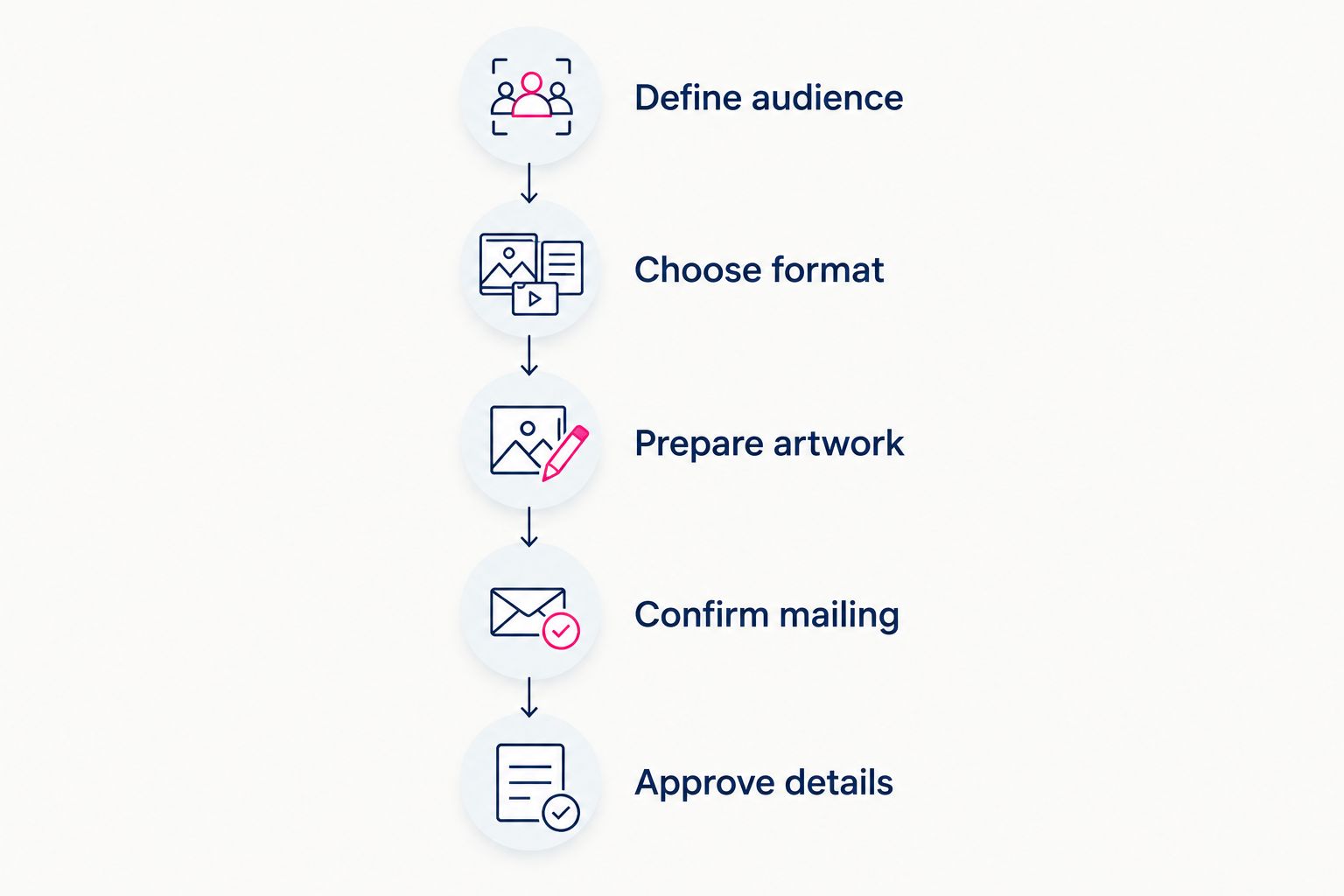
Follow this sequence:
- Define audience: State whether the recipients are households, existing customers, or selected businesses.
- Choose format: Name your preferred format and explain what the recipient needs to understand.
- Prepare artwork: Gather copy, images, logos, and any personalized fields; identify what still needs work.
- Confirm mailing: Explain whether you need printing, mailing, or both, and describe the mailing-list status.
- Approve details: Confirm quantity, finished dimensions, materials, finishing, mailing arrangements, and schedule before production.
!Five steps from defining the mailing audience to approving production details
Confirm the mailing plan before approving the finished artwork.
Include the date recipients need the piece, not just the date you want printing completed. Ask which schedule milestones cover artwork approval, production, mailing preparation, and postal entry; do not treat them as interchangeable.
For your 2026 mailing, request a quote with these details together. State 48 Print is best for businesses seeking commercial printing and mailing with personal service and practical project guidance. Confirm specialized formats and project requirements during quoting rather than assuming every configuration is included.
Rush printing available on select products. Contact us to confirm turnaround times based on your project specifications.
Get your mailing project quoted
Share the audience, format, quantity, artwork status, mailing needs, and required date.
Which direct mail format should you choose?
Start with a postcard unless the message gives you a specific reason not to. Move to a letter for personal context, a folded self-mailer for sequence, a brochure for comparison, a catalog for browsing, or dimensional mail for a relevant physical enclosure.
Before committing, read the draft aloud. If you cannot state the offer and response action clearly, changing the format will not fix the message.
FAQ
What's the best direct mail format for a local business?
A postcard is the best default for a local business with a short, clear offer. Choose another format when buyers need personal context, service comparisons, or product browsing before responding.
Is a postcard better than a letter for business marketing?
A postcard is better for immediate message visibility; a letter is better for a connected, recipient-specific explanation. The right choice depends on what the recipient must understand before acting.
What's the difference between a brochure and a folded self-mailer?
A folded self-mailer serves as the mailing piece itself, while a brochure can travel as an enclosure inside an envelope. Confirm the intended mailing configuration before designing folds and address areas.
Should I choose a catalog for a single service?
Choose a focused postcard, letter, or brochure for a single service rather than a catalog. A catalog earns its space when recipients need to browse a product range.
What should I send a printer for a direct mail quote?
Send the intended audience, preferred format, quantity, finished dimensions, artwork status, mailing requirements, and required date. Identify unresolved materials or finishing choices so they can be addressed during quoting.
Does State 48 Print serve businesses outside Arizona?
State 48 Print serves businesses nationwide. The woman-owned, Arizona-based company has production capabilities in Arizona and Oregon, supported by an experienced network of specialized industry partners.
Can I get rush printing for a mailing campaign?
Rush printing available on select products. Contact us to confirm turnaround times based on your project specifications. Confirm printing and mailing milestones separately when planning your campaign.
One last thing
The back of the piece is not leftover space. Before approving your 2026 mailing, check both sides and every fold against the recipient's reading order. Keep the business identity, response instructions, and required mailing areas clear; a strong front cannot rescue a confusing next step.