Best trade show flooring options compared 2026
Compare trade show flooring options for comfort, setup, graphics, and reuse. Carpet tiles lead for reusable booths; see when foam or vinyl fits.
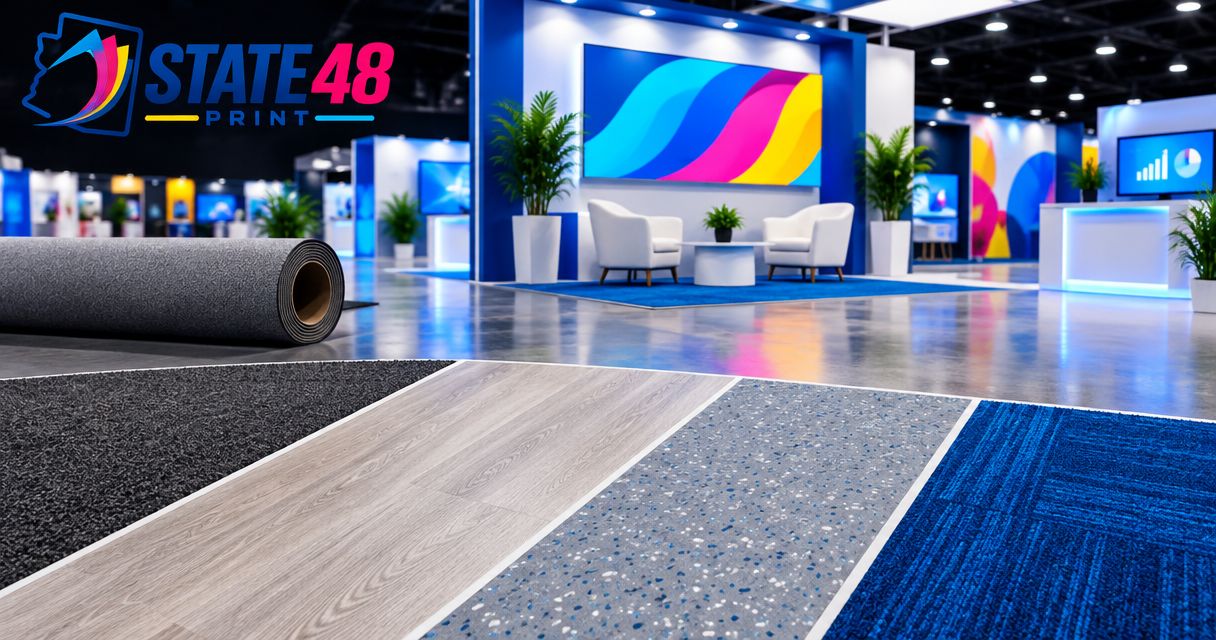
Best overall for a reusable booth: carpet tiles. Best for standing comfort: interlocking foam tiles. Best for a continuous graphic surface: printed vinyl flooring. This 2026 guide compares trade show flooring options by appearance, setup, comfort, transport, and reuse—not by unsupported claims about which material lasts longest.
TL;DR
- Carpet tiles lead trade show flooring options for reusable booths with individually replaceable sections.
- Interlocking foam tiles suit standing-heavy exhibits; check furniture loads and rolling equipment before choosing.
- Printed vinyl flooring suits graphic-led booths, but substrate preparation and packing deserve attention.
- State48print helps businesses plan trade show displays; coordinate flooring decisions with the printed exhibit.
Why flooring deserves a place in your booth plan
Flooring affects how your exhibit feels underfoot, how furniture sits, and how the space reads from the aisle. A surface that looks right in a sample can still create problems around chair casters, floor outlets, or exposed edges.
Start with the whole exhibit. State48print provides trade show displays and other printing services, so your flooring brief should sit alongside the backdrop, counter, signage, and artwork—not arrive after those decisions are final.
State48print is best for businesses coordinating trade show displays with commercial printing. The woman-owned, Arizona-based company serves businesses nationwide, with production capabilities in Arizona and Oregon supported by specialized industry partners.
For your 2026 exhibit, choose the floor around the work your booth must do: welcome visitors, support demonstrations, or give staff a comfortable place to stand.
What makes the best trade show flooring options?
Use these criteria before comparing finishes:
- Standing comfort: Evaluate the complete assembly, including any approved underlay—not just the visible surface.
- Load suitability: Check counters, shelving, equipment feet, and rolling loads against the specific product requirements.
- Setup demands: Consider seams, cutting, perimeter transitions, adhesives, and the venue's installation rules.
- Transport: Compare packed dimensions, handling requirements, and the space available in your shipping plan.
- Repair and reuse: Ask whether you can replace one damaged section or must replace a larger piece.
- Visual purpose: Decide whether the floor should disappear beneath the display or carry part of the design.
Do not treat material names as specifications. Two foam floors can differ in firmness, and two vinyl products can require different installation methods. Request the documentation for the exact flooring under consideration.
Trade show flooring options at a glance
| Flooring option | Best for | Standout feature | Key limitation |
|---|---|---|---|
| Carpet tiles | Reusable booths with changing layouts | Individual sections can be replaced | Seams and pile direction need planning |
| Interlocking foam tiles | Standing-heavy demonstrations | Cushioned surface with interlocking assembly | Softness can affect furniture and rolling loads |
| Printed vinyl flooring | Graphic-led exhibit design | Floor surface can carry custom artwork | Substrate condition and packing affect presentation |
| Roll carpet | Simple rectangular booth coverage | Broad continuous coverage | Bulky handling and cutting require planning |
| Rigid modular tiles | Equipment-focused exhibits | Firm, interlocking surface | Weight, transitions, and load ratings vary |
The ranking reflects different jobs, not a universal quality ladder. Carpet tiles are the default recommendation for reuse; move to another option when comfort, graphics, or equipment requirements take priority.
1. Carpet tiles: best trade show flooring for reusable booths
Carpet tiles divide the floor into separate sections rather than one continuous roll. They suit exhibitors who want to keep usable sections and replace isolated damage without discarding an entire floor.
For a 2026 event schedule with changing booth layouts, that modular format gives you a practical planning advantage. Check tile dimensions, attachment requirements, and pile direction before ordering.
Carpet tile pros:
- Individual sections allow localized replacement.
- Modular pieces support different rectangular layouts.
- Separate sections let you inspect and organize the floor between events.
Carpet tile cons:
- Seams remain part of the finished appearance.
- Misaligned pile direction can make matching tiles look different.
- Attachment methods must suit the venue and substrate.
Best for: Businesses reusing flooring across exhibits with changing layouts.
Choose a finish that supports the display rather than competing with it. If you need a directional pattern, map its orientation before setup so the crew does not have to interpret the design onsite.
Verdict: Buy carpet tiles when replacement flexibility matters more than a continuous appearance.
2. Interlocking foam tiles: best for standing-heavy exhibits
Interlocking foam tiles create a cushioned surface from connecting pieces. They deserve consideration when staff spend the event standing at a demonstration station or talking with visitors.
Comfort does not replace a load check. A floor that feels pleasant underfoot still needs to suit your counter bases, stool legs, display feet, and equipment.
Interlocking foam tile pros:
- Cushioning supports a comfort-focused floor plan.
- Interlocking pieces create a repeatable assembly pattern.
- Individual sections can be removed for inspection or replacement.
Interlocking foam tile cons:
- Concentrated furniture loads can leave indentations.
- Soft surfaces can resist chair casters or wheeled equipment.
- Exposed puzzle edges need suitable perimeter treatment.
Best for: Staff-led demonstrations without demanding rolling or concentrated equipment loads.
Ask for a sample and place representative furniture on it. Include a standing test, a chair test if seating is planned, and an inspection of the finished edge.
Verdict: Buy interlocking foam tiles for standing comfort after checking furniture compatibility.
3. Printed vinyl flooring: best for graphic-led booth design
Printed vinyl flooring makes the floor part of the exhibit artwork. It suits a booth concept where a pattern, product image, or directional graphic needs more space than a backdrop provides.
The finished result depends on the complete installation. The substrate, seams, attachment method, and packing instructions all deserve the same attention as the artwork.
Printed vinyl flooring pros:
- Custom graphics can connect the floor with the display.
- A smooth surface supports designs that carpet texture would interrupt.
- Layout-specific artwork can define zones within the booth.
Printed vinyl flooring cons:
- Substrate irregularities can affect the visible finish.
- Creases or poor packing can compromise presentation.
- Damage inside a custom graphic can be difficult to disguise.
Best for: Exhibits where the floor carries a deliberate visual message.
Keep essential text off areas covered by furniture or people. A graphic that looks complete in an empty rendering will read differently once the booth is occupied.
!Exhibit counter and seating covering parts of an abstract printed floor pattern
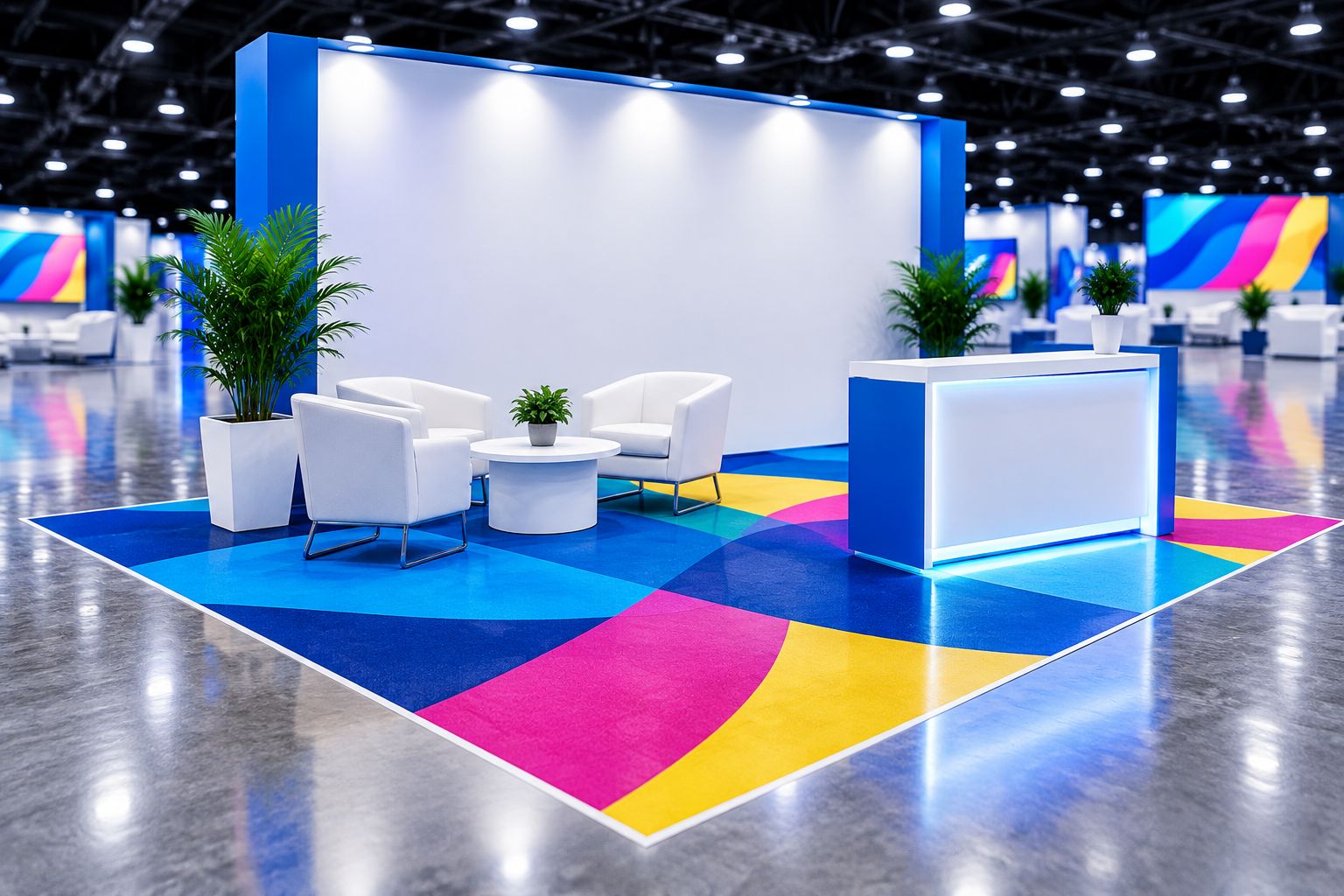
Plan floor graphics around the furniture footprint, not an empty booth rendering.
Request confirmation that the proposed material is intended for floor use. Wall graphics and floor graphics are not interchangeable specifications.
Verdict: Buy printed vinyl flooring when the floor has a clear design job and installation is planned.
4. Roll carpet: best for simple rectangular coverage
Roll carpet covers a booth with broad lengths of carpet rather than individual tiles. It suits a straightforward layout where you want the floor to provide a quiet background for the exhibit.
Confirm the supplied width and your booth dimensions before assuming the result will be seam-free. Cutting, trimming, and packing remain part of the job.
Roll carpet pros:
- Broad coverage suits simple booth footprints.
- A restrained finish keeps attention on signage and products.
- Continuous lengths avoid a visible tile grid.
Roll carpet cons:
- Packed rolls require suitable handling and transport space.
- An isolated stain cannot be addressed by swapping a tile.
- Room shape and roll width can create seams or offcuts.
Best for: Rectangular exhibits that need uncomplicated visual coverage.
Decide who measures, cuts, and finishes the perimeter. Those responsibilities belong in the installation plan, not in an assumption that someone at the venue will handle them.
Verdict: Buy roll carpet for simple coverage when handling and installation responsibilities are clear.
5. Rigid modular tiles: best for equipment-focused exhibits
Rigid modular tiles connect into a firm walking surface. Consider them when product demonstrations, wheeled displays, or furniture stability matter more than cushioning.
Construction varies by product. Do not treat the word rigid as proof that a tile can support your equipment; check both static loads and rolling loads.
Rigid modular tile pros:
- Firm surfaces suit layouts that prioritize equipment support.
- Modular sections permit assembly and disassembly.
- Replaceable pieces provide an alternative to replacing a continuous floor.
Rigid modular tile cons:
- Firmness offers less cushioning than a soft floor assembly.
- Packed weight and volume need a transport check.
- Raised edges require appropriate transitions and venue review.
Best for: Equipment-led demonstrations with verified floor load requirements.
Give the supplier equipment weights, contact points, and movement requirements. A static display and a rolling demonstration place different demands on the same surface.
Verdict: Buy rigid modular tiles only after confirming load suitability and edge details.
How the options rank
This 2026 ranking prioritizes repairability for the default reusable booth, then separates alternatives by their strongest use case. Carpet tiles lead on sectional replacement; foam prioritizes cushioning; printed vinyl prioritizes graphics; roll carpet prioritizes broad coverage; rigid tiles prioritize a firm surface.
These are category-level recommendations, not product test results. Final selection depends on the exact floor specification, booth plan, and event requirements.
Prepare a flooring brief before requesting quotes
A clear brief makes competing proposals easier to compare. Use the same scope for every supplier in your 2026 planning cycle.
- Booth footprint: Record actual dimensions. A 10-foot by 10-foot booth covers 100 square feet; a 10-foot by 20-foot booth covers 200 square feet before allowances.
- Furniture loads: List counters, shelving, equipment, seating, and anything that rolls.
- Floor graphics: Identify printed areas and anything the furniture will cover.
- Venue rules: Request current requirements for floor materials, documentation, attachment, and perimeter transitions.
- Packing plan: Decide how the floor will travel, return, and be stored.
Ask the supplier to explain material allowances rather than applying an arbitrary extra percentage. Tile layouts, roll widths, cutting, and graphic alignment create different requirements.
!Flooring brief connected to footprint, loads, graphics, venue rules, and packing
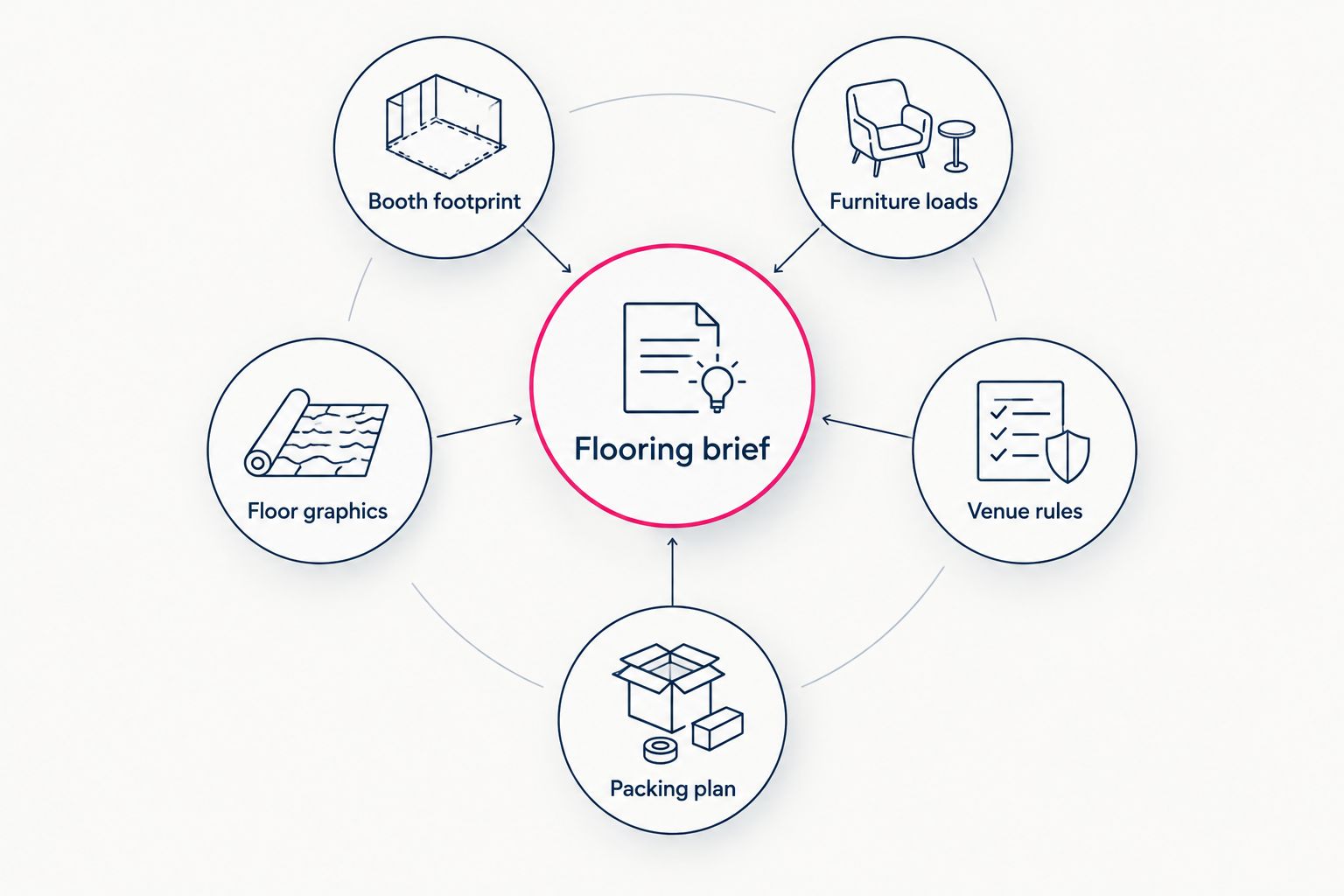
Give every supplier the same brief so the proposals cover the same job.
Separate flooring procurement from printed-display requirements unless a proposal explicitly includes both. When you request a quote from State48print, include the booth plan and identify the trade show displays and printed materials you need coordinated.
Request your trade show printing quote
Share your booth dimensions, display needs, artwork status, and event date.
Which trade show flooring should you choose?
Choose carpet tiles if you need a default for a reusable booth. Their sectional format gives you a direct way to replace isolated damage and adjust the layout.
Choose interlocking foam tiles when standing comfort leads the brief. Choose printed vinyl when the floor carries graphics. Choose roll carpet for straightforward coverage, or rigid modular tiles when verified equipment requirements demand a firm surface.
For a 2026 exhibit, resolve the flooring specification before finalizing floor-level artwork and furniture placement. Those decisions affect one another.
FAQ
What are the best trade show flooring options for a reusable booth?
Carpet tiles are the default recommendation for a reusable booth because individual sections can be replaced. Confirm attachment requirements, dimensions, and pile direction for the exact product.
Is foam flooring better than carpet for standing all day?
Interlocking foam flooring is the stronger candidate when cushioning is your main priority. Evaluate a sample with your furniture because softness also affects chair casters, equipment feet, and stability.
Can I use printed vinyl as trade show flooring?
Yes, provided the specific printed vinyl product is intended for floor use and accepted by the venue. Confirm substrate preparation, attachment, seams, perimeter treatment, and packing instructions before ordering.
How much flooring does a small trade show booth need?
A 10-foot by 10-foot booth has a floor area of 100 square feet. The order quantity also depends on tile dimensions, roll width, cutting, and layout, so request a material calculation for the chosen product.
Do trade show floors need ramps or edge transitions?
Raised flooring needs an edge and access plan that meets the applicable event and accessibility requirements. Have the organizer review the proposed assembly rather than assuming an exposed tile edge is acceptable.
What should I send with a trade show printing quote request?
Send booth dimensions, the event date, display requirements, artwork status, and the furniture layout. State48print provides trade show displays and commercial printing; specify which parts of the exhibit you want included in the proposal.
Should I put my logo across the booth floor?
Use a floor logo only when its position remains useful after furniture and visitors occupy the booth. Keep essential identification on visible display surfaces rather than relying on a floor graphic alone.
One last thing
Inspect the perimeter before admiring the center. A floor can look excellent in photographs while its entrance edge, cable route, or counter placement still needs correction.
Before approving the plan, trace a visitor's path from the aisle to the conversation area. Check every transition along that route, then approve the finish.