Best vehicle wrap types ranked by durability 2026
Compare vehicle wrap types ranked by durability. Choose cast vinyl for complex curves, match film to exposure, and prepare a clear business wrap quote.
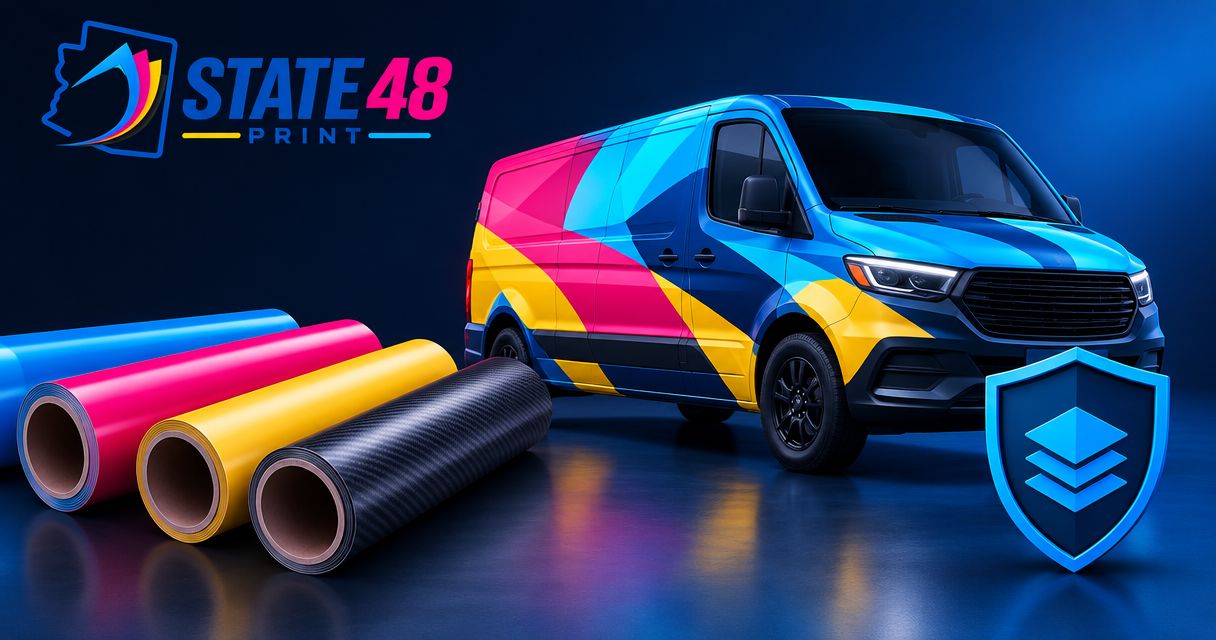
Best overall for durable graphics on complex curves: cast vinyl. Best for flat-panel campaigns: polymeric calendered vinyl. Best for temporary flat graphics: monomeric calendered vinyl. These are the vehicle wrap types ranked by durability for 2026; State 48 Print helps businesses plan vehicle wrap projects around the vehicle, artwork, and intended use.
TL;DR
- Cast vinyl leads vehicle wrap types ranked by durability for complex curves and long-term vehicle graphics.
- Polymeric calendered vinyl suits flat-panel graphics; do not treat it as a substitute for conformable cast film.
- Monomeric calendered vinyl belongs on temporary, flat graphics rather than demanding full wraps.
- State 48 Print is best for businesses seeking personal guidance on vehicle wrap project specifications.
Why this matters
A vehicle wrap is a system, not just a sheet of vinyl. Film construction, protective finish, surface condition, installation, exposure, and cleaning all affect the result. Buying by the word premium leaves those decisions unresolved.
For your 2026 vehicle graphics project, separate durability from coverage. A full wrap is a coverage choice; cast vinyl is a material choice. Neither a full wrap nor a partial wrap tells you which film is being used.
Choose the film for the surface first, then choose how much of the vehicle to cover. That order keeps your design from demanding more than the selected material can handle.
What makes the best vehicle wrap material?
Use these criteria before approving a quote:
- Conformability: The film must suit the vehicle's curves, recesses, and contours. A flat door panel and a deeply recessed body section are different applications.
- Dimensional stability: Resistance to shrinkage matters at edges, seams, and graphic boundaries. Film construction affects this behavior.
- Surface protection: Printed graphics need an appropriate protective system specified for the ink, film, and application.
- Exposure suitability: Vertical doors, horizontal hoods, outdoor parking, and sheltered parking do not create identical exposure conditions.
- Removal requirements: Check the specific film's removal guidance and the condition of the paint underneath. Do not assume every adhesive behaves alike.
- Documented application limits: The manufacturer's technical information matters more than a generic description such as commercial-grade vinyl.
These criteria also explain why a material that works on a delivery van's flat side might be unsuitable for wrapping a sculpted bumper.
Vehicle wrap durability at a glance
This 2026 ranking compares material families for vehicle graphics. It is an application-based buying guide, not a measured service-life test. Individual film specifications take precedence over the category name.
| Rank and material | Best for | Standout characteristic | Key limitation |
|---|---|---|---|
| 1. Cast vinyl | Long-term graphics on complex vehicle contours | Conformability and dimensional stability | Requires a film and installation approach suited to the particular recesses |
| 2. Polymeric calendered vinyl | Flat or gently curved panel campaigns | A practical option for less demanding surfaces | Not interchangeable with cast film on deep contours |
| 3. Monomeric calendered vinyl | Temporary graphics on flat panels | A material category for limited-scope promotional work | Poor choice for demanding curves and long-term wrap expectations |
Coverage styles and finishes belong in a separate discussion. Full wraps, partial wraps, gloss, and matte are not equivalent material categories, so they do not receive their own durability ranks here.
1. Cast vinyl: best for durable wraps on complex curves
Cast vinyl is the strongest default when your design crosses compound curves and other demanding vehicle contours. Its manufacturing process produces a film with the conformability and dimensional stability associated with long-term vehicle wrapping.
That does not make every cast product suitable for every recess. The exact film's application instructions still control where it belongs and how it must be installed.
Cast vinyl pros:
- Suits complex vehicle shapes when the selected product permits them.
- Offers dimensional stability that helps limit shrinkage-related problems.
- Supports both printed graphics and color-change applications through different purpose-made products.
- Provides a sensible starting point for long-term fleet graphics specifications.
Cast vinyl cons:
- Cannot compensate for failing paint, contamination, or poor preparation.
- Still requires careful installation around edges, recesses, and seams.
- The cast label alone does not establish the complete wrap system's suitability.
Best for: Businesses planning long-term graphics on vehicles with curved or recessed bodywork.
For printed work, ask which film, ink, and protective laminate form the proposed system. For a color-change application, ask about the selected film's factory finish and application limits instead of assuming it needs the same construction as a printed graphic.
Verdict: Buy cast vinyl for demanding contours, subject to the exact product's approved applications.
2. Polymeric calendered vinyl: best for flat-panel campaigns
Polymeric calendered vinyl is an option for vehicle graphics on flat or gently curved surfaces when the product's technical guidance permits that use. It belongs in a different application conversation from a full wrap across complex contours.
The useful question is not whether polymeric film is good or bad. It is whether your graphic stays within the material's limits throughout its intended use.
Polymeric calendered vinyl pros:
- Fits flat-panel graphic projects without treating every panel as a complex-wrap application.
- Supports printed campaign graphics when paired with a suitable protective system.
- Gives you another material option when the design avoids demanding recesses.
Polymeric calendered vinyl cons:
- Has less conformability than cast wrap film for complex shapes.
- Requires attention to shrinkage, edges, and application restrictions.
- Is not a blanket substitute for cast vinyl across an entire vehicle.
Best for: Businesses placing campaign graphics on flat panels or suitable gentle curves.
Show the printer the actual panel before choosing this category. A drawing that looks flat on a screen can conceal a crease, channel, or transition on the vehicle itself.
Verdict: Buy for suitable flat-panel campaigns; skip it where the design demands complex conformability.
3. Monomeric calendered vinyl: best for temporary flat graphics
Monomeric calendered vinyl belongs at the temporary end of this ranking. Consider it for limited-duration graphics on flat surfaces only when the specific product is approved for that application.
Do not select it for a full vehicle wrap simply because the artwork can be printed on it. Printability does not establish long-term dimensional stability, removability, or suitability for curved bodywork.
Monomeric calendered vinyl pros:
- Fits temporary promotional work on suitable flat surfaces.
- Keeps short-term graphics separate from long-term wrap specifications.
- Can serve straightforward designs that avoid demanding contours, subject to product guidance.
Monomeric calendered vinyl cons:
- Has greater dimensional-stability limitations than the higher-ranked material families.
- Is unsuitable as a general recommendation for complex vehicle wraps.
- Requires explicit checks on application and removal conditions.
Best for: Businesses running temporary promotions on flat vehicle panels where the selected film is approved.
A temporary campaign still needs a removal plan. Record when the graphic should come off, who will remove it, and what condition the underlying paint is in before application.
Verdict: Buy only for an approved temporary flat application; skip for long-term full wraps.
How the materials are ranked
The ranking prioritizes conformability and dimensional stability because vehicle graphics face shape-related stresses that flat signs do not. Protection, exposure, and removal requirements then determine whether a particular film system fits your project.
Cast vinyl ranks first for demanding vehicle contours. Polymeric calendered vinyl occupies the flat-panel campaign slot. Monomeric calendered vinyl occupies the temporary flat-graphics slot.
This is not a claim that every cast film outlasts every calendered film under every condition. A category ranking narrows your options; the product specification decides the application.
What changes durability after you choose the film?
Exposure and panel orientation
For a 2026 Arizona wrap project, ask how sun exposure and panel orientation affect the selected material's stated performance. Do not apply a vertical-panel durability statement automatically to a hood or roof.
The same question matters outside Arizona. Explain where the vehicle operates and whether it normally parks indoors or outdoors so the specification reflects its actual use.
Paint condition and preparation
A wrap depends on the surface beneath it. Disclose repainting, clear-coat problems, rust, existing graphics, and visible damage before the job is specified.
Vinyl is not a repair for failing paint. Ask for a surface assessment rather than assuming coverage will make an unstable substrate suitable.
Protection and care
For printed wraps, confirm that the proposed protective laminate is compatible with the film and ink system. Do not assume adding any laminate creates a suitable vehicle-wrap combination.
Request care instructions for the exact installed product. Follow those instructions for washing, chemicals, and cleaning equipment instead of relying on generic advice for every vinyl finish.
Prepare a wrap quote that answers the durability question
State 48 Print is a woman-owned, Arizona-based commercial printing company serving businesses nationwide. Its production capabilities in Arizona and Oregon are supported by an experienced network of specialized industry partners for additional services, capacity, and nationwide coverage.
State 48 Print is best for businesses that want personal guidance on vehicle wrap specifications. Bring a clear brief so the discussion starts with the vehicle and intended use, not a vague request for the most durable vinyl.
Include these details in your 2026 quote request:
- Vehicle details: Make, model, body configuration, and any aftermarket equipment that affects graphic placement.
- Surface photos: Start with 3 photographs per vehicle: each side and the rear. Add close-ups of damaged paint, recesses, or existing graphics.
- Coverage plan: Identify the panels you want covered and those you want left exposed.
- Service expectations: Explain the intended campaign duration, operating environment, parking conditions, and removal plans.
- Artwork: Supply your logo files, required wording, and any existing design files for review.
- Schedule: State the date you need the vehicle ready and any limits on taking it out of service.
!Vehicle wrap quote checklist covering photos, coverage, service expectations, artwork, and schedule.
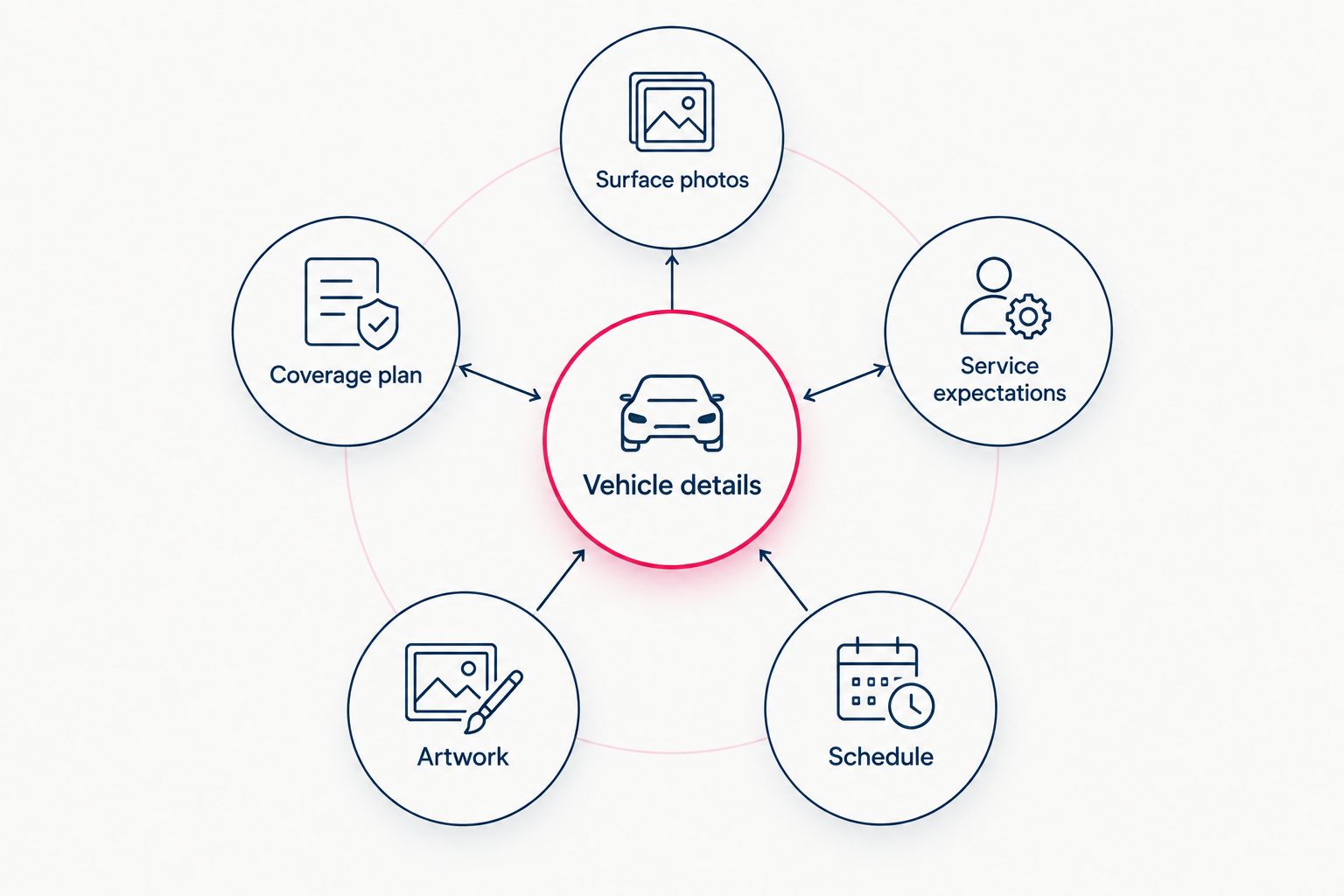
A useful quote brief connects the vehicle's condition with the intended graphics and operating conditions.
Review the design at 2 viewing distances: close enough to inspect layout details, and farther away to check the main business name and message. This is a practical review exercise, not a substitute for production-file checks.
Choose 1 final proof approver for your business. Consolidated feedback helps keep the coverage plan, wording, and vehicle details consistent before production.
Ask State 48 Print to identify the proposed material construction and explain why it fits the intended application. Then request a quote with your photos and project details.
Get your vehicle wrap quote
Share vehicle photos, intended coverage, artwork, and timing to discuss your project specifications.
Which vehicle wrap type should you choose?
Choose cast vinyl as the default for long-term vehicle graphics that cross complex contours. Choose polymeric calendered vinyl only where the surface and product guidance support a flat-panel campaign. Reserve monomeric calendered vinyl for approved temporary flat applications.
For your 2026 purchase, compare proposed film systems rather than accepting matching descriptions such as full wrap or premium vinyl. Ask about the material, protective finish, surface requirements, application limits, and removal guidance before approving the work.
FAQ
What's the most durable type of vehicle wrap?
Cast vinyl is the strongest default for long-term vehicle graphics on complex contours because of its conformability and dimensional stability. The exact film, protective system, surface, exposure, and installation still determine suitability.
Is cast vinyl better than calendered vinyl for a full wrap?
Cast vinyl is generally the better choice for a full wrap that crosses compound curves or demanding contours. Calendered films belong on applications permitted by their specific technical guidance, rather than being treated as direct substitutes.
Does a full wrap last longer than a partial wrap?
Coverage alone does not determine durability. Compare the film system, surface condition, panel orientation, installation, and care rather than assuming a full wrap lasts longer.
Does laminate make printed vehicle graphics more durable?
A suitable laminate provides protection for printed graphics as part of a compatible film and ink system. It does not correct unsuitable vinyl, failing paint, or installation problems.
How many years will a vehicle wrap last in Arizona?
There is no single service-life figure for every Arizona vehicle wrap. Ask for the selected product's exposure-specific guidance, including distinctions between vertical panels and horizontal surfaces.
Is matte vinyl more durable than gloss vinyl?
Matte versus gloss alone is not enough to rank durability. Compare the actual product specifications and care requirements rather than treating surface appearance as a material grade.
What should I send when requesting a vehicle wrap quote?
Send vehicle details, photographs, the desired coverage, artwork, intended use, and your required schedule. Disclose damaged or repainted surfaces and explain when the graphics will need removal.
One last thing
The most useful durability question is not just how long the vinyl lasts. Ask where that durability statement applies. A claim for a vertical door panel does not automatically describe the same material on a horizontal hood.
Before approving your 2026 wrap, make sure the proposed material is suitable for every surface the design covers. That check is more useful than choosing a film by its finish alone.