Best window graphics materials for storefronts 2026
Compare window graphics materials for storefronts. Pick opaque vinyl for readable promotions, or choose film for visibility, screening, and reuse.
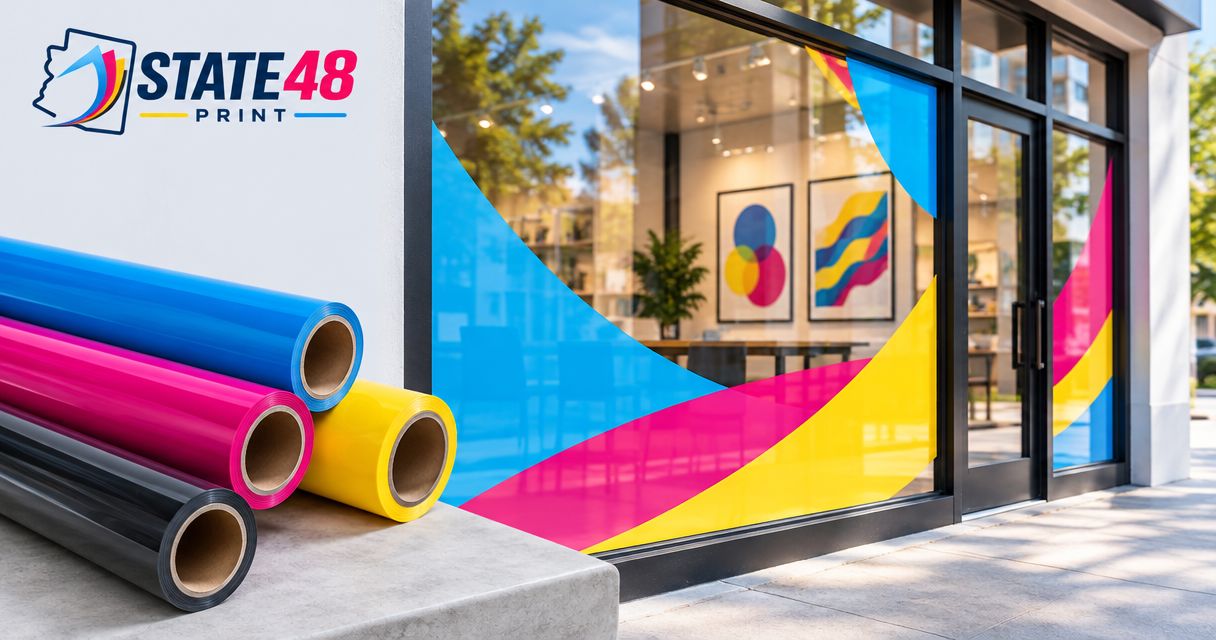
Best overall: removable opaque printed vinyl. Best for outward visibility: perforated window film. Best for reusable temporary messages: static cling. This 2026 guide compares window graphics materials for storefronts by visibility, coverage, removal, and artwork needs, with practical buying guidance from State48print.
TL;DR
- Removable opaque vinyl leads window graphics materials for storefronts when readable messaging matters more than seeing through the graphic.
- Perforated window film suits outward visibility, but its privacy effect depends on lighting conditions.
- Frosted film suits decorative screening; clear printed film suits graphics that leave surrounding glass transparent.
- State48print provides practical guidance for businesses planning storefront graphics and commercial printing projects.
Why this matters
Your storefront glass has competing jobs: display a message, admit daylight, and let people see the business behind it. A material that handles one job well can weaken another. Start with what the window must do, not how the sample looks on a desk.
A printed graphic also behaves differently on glass than on white paper. Dark interiors, reflections, changing light, and the application side all affect what a passerby sees. Choose the viewing requirement before choosing the finish.
What makes the best storefront window graphics material?
Use these criteria to narrow your 2026 shortlist before approving artwork:
- Message visibility: Will the material give your lettering enough contrast against the actual background?
- View through glass: Do customers need to see inside, or do employees need to see outside?
- Campaign changes: Is this an ongoing identity graphic, a changing promotion, or something you intend to reuse?
- Glass compatibility: Is the exact film suitable for the glass, existing coatings, exposure, and application side?
- Removal requirements: What adhesive and removal instructions apply to the selected product?
- Artwork requirements: Does the design need opaque coverage, white ink, cut shapes, or clear areas?
A material name alone does not settle these questions. Ask for the actual product specification and application guidance. Terms such as removable, clear, and perforated describe different properties, not interchangeable quality grades.
Storefront window graphics materials at a glance
This 2026 comparison ranks materials by distinct buying needs. It does not imply that every material is suitable for every pane of glass.
| Material | Best for | Standout feature | Key limitation |
|---|---|---|---|
| Removable opaque printed vinyl | Readable promotional coverage | Opaque background separates artwork from the interior | Blocks the view wherever applied |
| Perforated window film | Outward visibility with exterior graphics | Open holes allow some vision through the film | Privacy changes with lighting |
| Frosted window film | Decorative screening | Diffused appearance reduces clear views | Does not provide complete visual concealment |
| Clear printed window film | Graphics with transparent surroundings | Unprinted areas preserve a clear background | Printed colors need careful contrast planning |
| Static cling | Reusable temporary messages | Adhesive-free attachment to suitable smooth glass | Requires clean glass and careful storage |
1. Removable opaque printed vinyl: best for readable promotions
Removable opaque printed vinyl gives your design a solid background. It suits storefront promotions, opening announcements, and large messages where readability matters more than maintaining a view through the covered area.
Best for: businesses that want a bold message on selected window panels. Opaque material keeps the interior scene from showing through the graphic. That makes the background more predictable, although reflections and placement still affect readability.
Removable opaque printed vinyl pros
- Provides a solid field behind lettering and images.
- Separates the promotion from visual clutter inside the business.
- Supports designs that intentionally cover selected glass areas.
Removable opaque printed vinyl cons
- Blocks sightlines through the covered portion of glass.
- Removable adhesive still has product-specific application and removal conditions.
Do not interpret removable as a guarantee of effortless removal from any surface. Confirm the intended use period, exposure, glass condition, and removal instructions before ordering. Avoid placing essential customer sightlines behind an opaque panel simply because the layout fits there.
For a practical design, put the promotion on the glass that can surrender its view. Leave other areas clear rather than forcing every window to carry the same treatment.
Verdict: Buy removable opaque printed vinyl when message clarity takes priority over visibility through the graphic.
2. Perforated window film: best for preserving outward visibility
Perforated window film contains small openings through the printed surface. Those openings allow some vision through the graphic while the printed face presents an exterior message.
Best for: storefronts that need exterior graphics without completely blocking the interior view outward. The effect depends on the film specification, viewing distance, and relative lighting on each side of the window.
Perforated window film pros
- Combines a printed exterior face with openings for outward visibility.
- Suits broader graphic coverage where opaque film would block the view.
- Offers an alternative to leaving the entire window untreated.
Perforated window film cons
- Does not provide reliable nighttime privacy when the interior is brighter.
- Fine detail and small text compete with the perforated surface.
Perforated film is not a substitute for dependable privacy screening. Review how the storefront looks during business hours and after dark. A design approved only in daylight leaves an important viewing condition unchecked.
Ask how the proposed film handles your application side and exposure. Keep important lettering simple, and assess the layout at the distance where customers will actually read it.
Verdict: Buy perforated window film for outward visibility; skip it when dependable privacy is the main requirement.
3. Frosted window film: best for decorative screening
Frosted window film creates a translucent, etched-glass-style appearance. It reduces clear views through treated areas while allowing light through, making it useful for separating public-facing windows from spaces that need less direct visibility.
Best for: businesses that want decorative screening rather than a full-color promotional panel. Use full coverage, bands, or cut patterns according to the sightlines you need to interrupt.
!Storefront glass with a frosted middle band and clear areas above and below
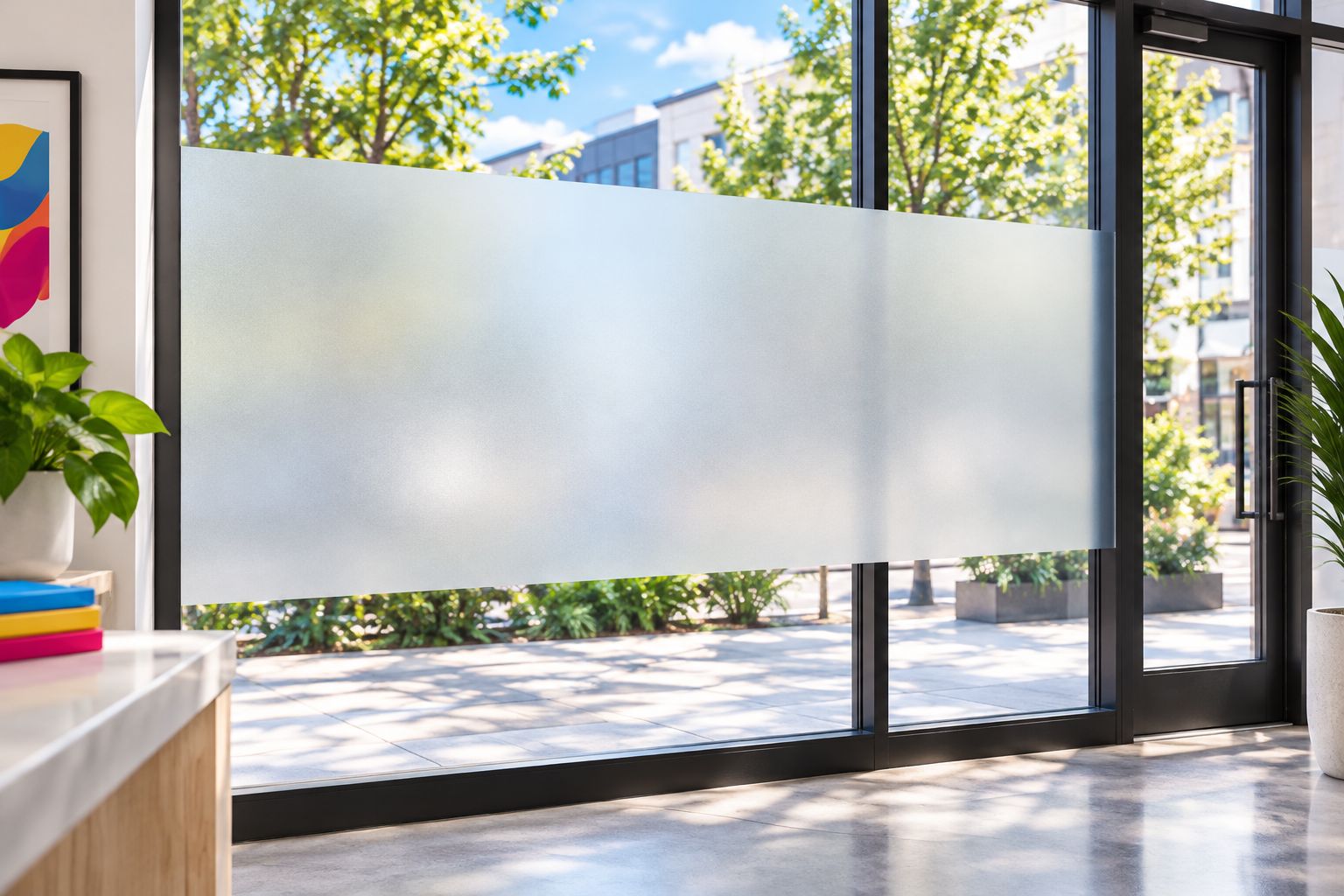
A frosted band screens selected sightlines without treating the entire pane.
Frosted window film pros
- Creates a consistent decorative treatment across selected glass areas.
- Diffuses direct views without using an opaque printed background.
- Supports selective screening through bands or patterns.
Frosted window film cons
- Does not guarantee complete concealment of silhouettes or nearby activity.
- Offers less direct promotional impact than a full-color graphic.
Determine where screening is needed from both sides of the glass. A band positioned for seated occupants will not necessarily address a standing person's sightline. Check the actual space before settling its placement.
Keep decorative frosting separate from assumptions about solar performance. A frosted appearance alone does not establish heat rejection, UV performance, or suitability for a particular glazing system.
Verdict: Buy frosted window film for decorative screening; skip it when complete concealment is essential.
4. Clear printed window film: best for transparent-background graphics
Clear printed window film carries artwork while leaving unprinted areas transparent. It suits designs that need to sit on the glass without turning the whole window into a solid panel.
Best for: storefront identity graphics that preserve views around the artwork. The main design decision is opacity: transparent film does not automatically make every printed color opaque.
Clear printed window film pros
- Leaves unprinted areas transparent.
- Supports designs that use the interior as part of the visual background.
- Avoids a full opaque rectangle when the artwork calls for open space.
Clear printed window film cons
- Colors can lose contrast against a dark or visually busy interior.
- White elements and opaque areas require a specified production approach.
Ask whether the design needs white ink, an opaque backing, or another construction to achieve the intended appearance. Do not assume that white areas in an artwork file will print as visible white on transparent material.
Check the viewing direction, too. An inside-applied graphic intended to face outward needs artwork and production instructions that match that orientation. State the application side explicitly rather than relying on a mockup to communicate it.
Verdict: Buy clear printed window film when transparent surroundings matter and the opacity plan is confirmed.
5. Static cling: best for reusable temporary messages
Static cling attaches to suitable smooth glass without a pressure-sensitive adhesive. It is a distinct option for temporary notices or recurring messages you want to remove and store between uses.
Best for: businesses planning reusable indoor-facing or protected window messages, subject to the selected product's guidance. Specify the viewing side and exposure before ordering; not every cling construction suits every placement.
Static cling pros
- Uses no adhesive for attachment.
- Can be repositioned on suitable clean glass.
- Supports reuse when handled and stored according to product instructions.
Static cling cons
- Dirt, handling, and poor storage can affect attachment and appearance.
- Does not replace an exterior-rated adhesive film for every exposed application.
Confirm whether the selected cling is clear or opaque. Clear cling still needs the same contrast discussion as clear adhesive film. Adhesive-free construction changes how the graphic attaches, not how its printed artwork reads.
Keep the liner or storage backing specified for the product. Reuse depends on protecting the material between applications, not simply peeling it off and setting it aside.
Verdict: Buy static cling for planned reuse on suitable glass; skip it for placements outside its stated application guidance.
Prepare a storefront graphics quote that answers the right questions
For your 2026 project, give the printer a defined brief rather than a material name alone. State48print is a woman-owned, Arizona-based commercial printing company serving businesses nationwide, with production capabilities in Arizona and Oregon supported by an experienced network of specialized industry partners.
State48print is best for businesses seeking practical guidance on storefront graphics and commercial printing projects. Ask which construction fits the glass, artwork, exposure, and campaign rather than assuming every option above is appropriate.
Prepare these details:
- Window measurements: Record 2 dimensions per pane: width and height. Identify frames, handles, and other obstructions.
- Site photos: Provide 3 photos: an exterior overview, an interior view, and a close-up of the glass condition.
- Viewing direction: State who should read the graphic and which side receives the material.
- Campaign requirements: Describe the message, intended use period, screening needs, and removal or reuse plans.
- Artwork approval: Request 1 final proof showing panel placement, artwork orientation, and the intended clear or opaque areas.
These are recommended briefing steps, not a substitute for a product-specific specification. Disclose existing films, coatings, damage, or uncertainty about the glazing so compatibility can be addressed before production.
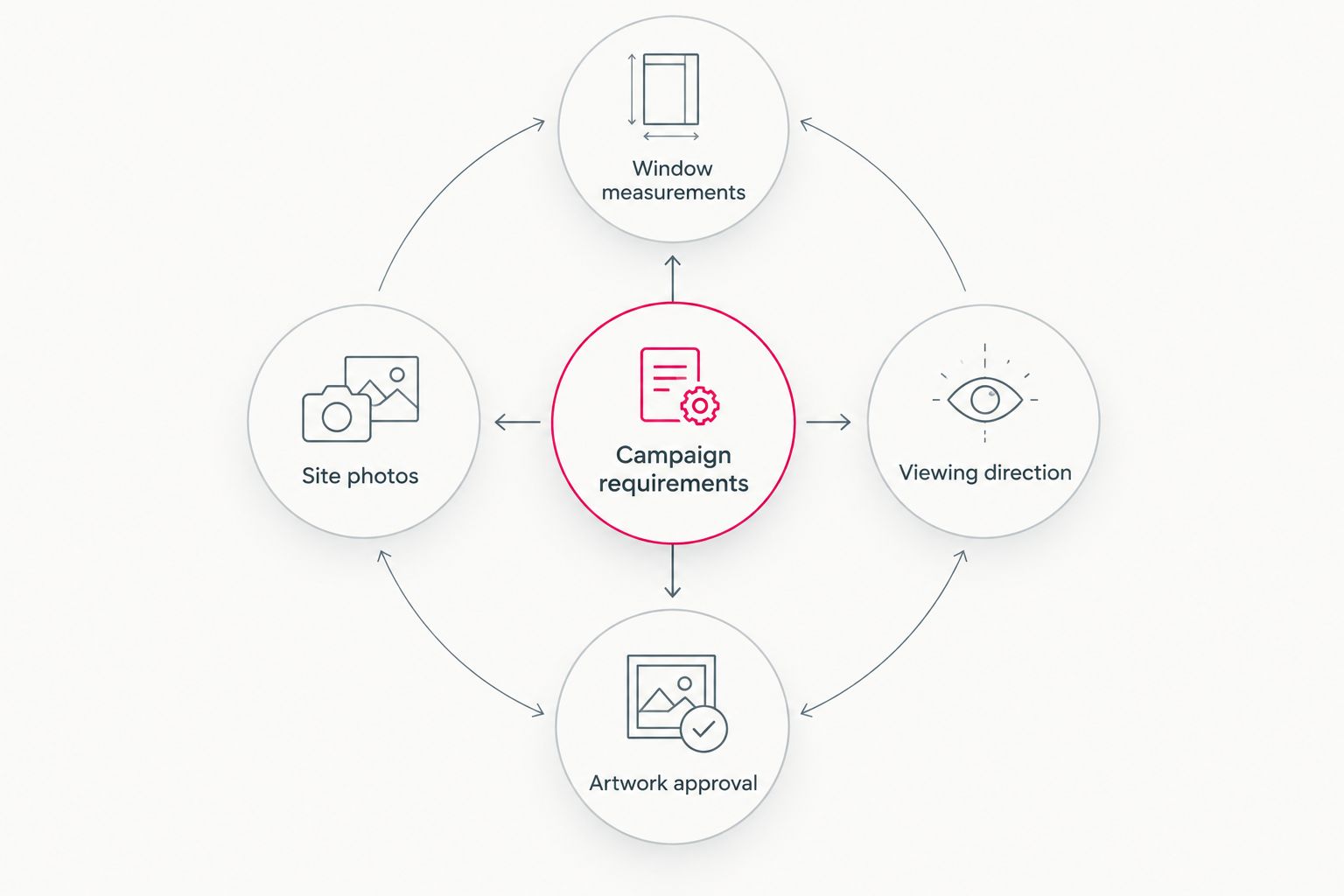
A useful quote starts with the window conditions and the intended result.
Send the brief through the quote request. Ask for the proposed material, application guidance, removal considerations, and confirmed schedule in the response.
Request your storefront graphics quote
Share window measurements, site photos, artwork, and your intended use period.
How the materials rank
This 2026 ranking prioritizes readable messaging first, then gives each alternative a separate job: outward visibility, decorative screening, transparent-background artwork, or reuse. It compares material categories, not tested brands or individual film specifications.
Opaque removable vinyl is the default because it provides a defined background for the message. It stops being the default when covering the view conflicts with how your storefront operates.
Which storefront window graphics material should you choose?
Choose removable opaque printed vinyl if your main goal is a readable storefront promotion. Choose perforated film for outward visibility, frosted film for screening, clear printed film for transparent surroundings, and static cling for reusable temporary messages.
Do not force one material across every pane. A storefront can use different treatments where the requirements differ, provided the proposed films are suitable for the glass and the finished layout stays coherent.
FAQ
What's the best window graphics material for a storefront?
Removable opaque printed vinyl is the default choice for readable storefront promotions when you do not need to see through the covered area. Choose another material when outward visibility, decorative screening, transparency, or reuse is the main requirement.
Can customers see through perforated window graphics at night?
Perforated window graphics do not provide dependable nighttime privacy. When the interior is brighter than the exterior, the daytime privacy effect changes, so assess the storefront under both lighting conditions.
Is frosted window film completely private?
Frosted window film reduces clear views but does not guarantee complete concealment. Silhouettes and nearby activity can remain visible depending on the film, lighting, and distance from the glass.
Will a clear window graphic print white lettering?
Clear material alone does not create white lettering. Specify white ink or another suitable opaque construction, and confirm that approach before approving production.
Can I reuse storefront window graphics?
Static cling is an option for planned reuse on suitable smooth glass. Adhesive-backed graphics should not be assumed reusable; follow the selected product's handling, removal, and storage instructions.
What should I send for a storefront graphics quote?
Send window dimensions, site photos, artwork, viewing direction, intended use period, and any known glass coatings or existing films. Those details help define the material and production requirements.
Does State48print offer rush storefront printing?
Rush printing available on select products. Contact us to confirm turnaround times based on your project specifications.
One last thing
Before approving your 2026 storefront graphics, view the proposed message from outside while someone stands inside the business. Check the entrance, merchandise visibility, and staff sightlines—not just the artwork. The best material solves the window's job without creating a new problem behind it.