Promotional products for nonprofit organizations: complete 2026 guide
Promotional products for nonprofit organizations work best with a clear purpose. Choose useful items, prepare artwork, and build a focused quote request.

Promotional products for nonprofit organizations are branded items used to support fundraising, recognize supporters, and equip volunteers in 2026. Choose them around a specific audience and action—not around how many objects you can put a logo on—and account for storage, distribution, and staff time before ordering.
TL;DR
- Promotional products for nonprofit organizations need a defined audience, campaign purpose, and distribution plan.
- State 48 Print suits nonprofits coordinating promotional products, branded apparel, and commercial printing.
- Choose donor gifts, volunteer apparel, and fundraising merchandise for different jobs—not as interchangeable giveaways.
- Compare usefulness, decoration requirements, and fulfillment responsibilities before approving a quote.
Why promotional products matter for nonprofits
Nonprofit merchandise has to do more than carry your name. A volunteer shirt identifies the team. A useful supporter gift acknowledges participation. An item sold at a fundraiser needs a clear explanation of what the purchase supports. Those are different assignments, and each calls for different buying decisions.
Start with the job, then choose the item. A product that fits the mission but has no distribution plan becomes another box your staff must manage. An attractive giveaway also cannot substitute for a clear donation request, volunteer invitation, or follow-up message.
State 48 Print is a woman-owned, Arizona-based commercial printing company serving businesses nationwide. Its production capabilities in Arizona and Oregon are supported by an experienced network of specialized industry partners for additional services, capacity, and nationwide coverage.
State 48 Print is best for nonprofits that need promotional products and commercial printing from one company. Confirm the proposed item's specifications and project responsibilities when requesting a quote; a broad service offering does not make every product interchangeable.
Build your 2026 nonprofit merchandise plan
Define one audience and one action
Start with a blank document or spreadsheet. Name 1 primary audience and 1 campaign action before reviewing product ideas. These are planning limits, not performance benchmarks: they keep the brief focused enough to guide a purchase.
A recurring donor, an event attendee, and a volunteer arrive with different relationships to your organization. Decide whether the item thanks someone for past support, helps someone participate, or accompanies something you want them to do next. Do not make the object carry every organizational message at once.
Write the purpose in a sentence your board, program staff, and printer can all understand. For example, volunteer apparel can identify the event team; a supporter notebook can accompany a program update. Neither choice needs an unsupported promise about future donations.
- Name the audience receiving the item.
- State the action or recognition purpose.
- Identify where the handoff happens.
- Assign a staff owner to distribution.
- Define what a successful distribution looks like.
Separate gifts, merchandise, and volunteer equipment
Create separate lines in your spreadsheet for appreciation gifts, items offered for sale, and volunteer equipment. Keeping these uses separate prevents a single order from becoming an unclear mix of fundraising inventory and operational supplies.
Best for supporter appreciation: choose something appropriate to the relationship and explain why you are sending it. Best for fundraising merchandise: choose an item your audience understands without a lengthy sales explanation. Best for volunteer identification: prioritize visible decoration, practical fit, and the conditions in which people will wear or carry it.
Ask program and event staff what recipients actually need before selecting a category. Their answers should shape the brief, not create an unlimited wish list. Record any restrictions on messaging or distribution before artwork begins.
- Label each item by its intended use.
- Separate sold inventory from gifts.
- Collect volunteer sizing needs privately.
- Identify who approves recipient messaging.
- Check relevant fundraising and accounting requirements.
Build a comparable quote brief
Prepare the first version yourself using a shared document. Record the item type, intended use, quantities, decoration locations, delivery destination, and required arrival date. Ask each prospective supplier to respond to the same brief so differences in the proposals are visible.
State 48 Print offers promotional products, branded apparel, commercial printing and mailing, signage, and other printing services. Its personal service and practical guidance provide a route for discussing coordinated needs rather than treating every piece as an unrelated purchase. The printing services overview is the starting point for matching the brief to those service categories.
The limitation is straightforward: a service list is not a product specification. Confirm materials, decoration methods, packing arrangements, and production responsibilities for the actual project. Do not assume apparel, printed inserts, and event signage share a production schedule.
- Supply 3 quantity scenarios for comparison.
- Separate essential features from preferences.
- Specify every decoration location.
- Identify any accompanying printed materials.
- Request written confirmation of project responsibilities.
Choose items around real use
Begin with the recipient's setting. A tote bag needs a reason to be carried; a notebook needs a reason to be kept nearby. Apparel needs sizing decisions and a distribution method. Familiarity alone is not a sufficient reason to order any of them.
Compare the item with the task it must perform. If volunteer recognition is the goal, a usable garment and a clear thank-you message deserve more attention than elaborate packaging. If an event handout is the goal, consider what attendees already carry and how your team will distribute it.
Review a sample when one is available, and ask what the sample represents. A blank item helps you assess the object; it does not show how your final decoration will reproduce. Treat those as separate approvals.
- Check dimensions against the intended use.
- Review material and care information.
- Assess decoration placement and visibility.
- Consider carrying, storage, and packing needs.
- Confirm whether samples show final decoration.
!Blank tote bag, notebook, bottle, and folded shirt arranged for an event merchandise review

Evaluate the object and its intended use before deciding where the logo belongs.
Prepare artwork for the actual decoration area
Gather your existing logo files and brand guidance before commissioning new artwork. Ask the printer which file formats, color references, and artwork dimensions the selected decoration process requires. A file that looks sharp on a presentation slide is not automatically suitable for production.
Approve artwork at the size and placement proposed for the item. Review small text, fine details, and the relationship between the logo and the available space. A large mission statement can make a small decoration area harder to read rather than more informative.
For a 2026 campaign, separate temporary event information from the organization's lasting identity. Put a date on the product only when the date serves the item's purpose. Otherwise, campaign details can live on an accompanying printed piece that changes without redesigning the merchandise.
- Send original logo files when available.
- Confirm the usable decoration area.
- Check spelling and approved organization names.
- Review contrast against the item color.
- Test every printed web address or code.
- Name the person authorized to approve proofs.
Plan the handoff before production
Map the route from finished item to recipient. Event pickup, office distribution, and individual mailing require different preparation. Write down who receives the shipment, who checks it, where it waits, and who handles the final handoff.
Use a shared checklist before adding another system or service. Count storage space and staff handling as project requirements, even when volunteers perform the work. For clothing, decide how sizes will be labeled and distributed without turning the event check-in table into a sorting station.
Ask about packaging and shipment arrangements rather than assuming they are included. Production completion, shipment, and arrival are separate milestones. Set the required arrival date against the actual event or mailing plan, then confirm the proposed schedule in writing.
- Identify the receiving location and contact.
- Reserve suitable storage space.
- Assign inspection and counting responsibilities.
- Define size or recipient sorting needs.
- Plan for leftover inventory.
- Confirm shipment and arrival expectations.
Approve the full plan and measure its purpose
Bring the brief, artwork, schedule, and distribution plan together before authorizing production. Check that the final quote reflects the latest version of each. A revised quantity or decoration location belongs in the written approval, not only in an email conversation someone might miss.
Use the same approval sequence for a small order and a large campaign. The decision points remain the same even when the project size changes. Keep one approved version accessible to the person receiving the finished goods.
Schedule a 30-day review after distribution as an internal checkpoint, not as a promised response window. Record what was distributed, what remains, and what recipients or staff reported. Separate those observations from claims that merchandise caused donations or repeat participation.
- Campaign purpose: confirm the audience and intended use.
- Artwork files: identify the approved version.
- Item quantities: reconcile the final order.
- Delivery details: confirm destination and timing.
- Proof approval: record the authorized sign-off.
- Results review: compare distribution with the original purpose.
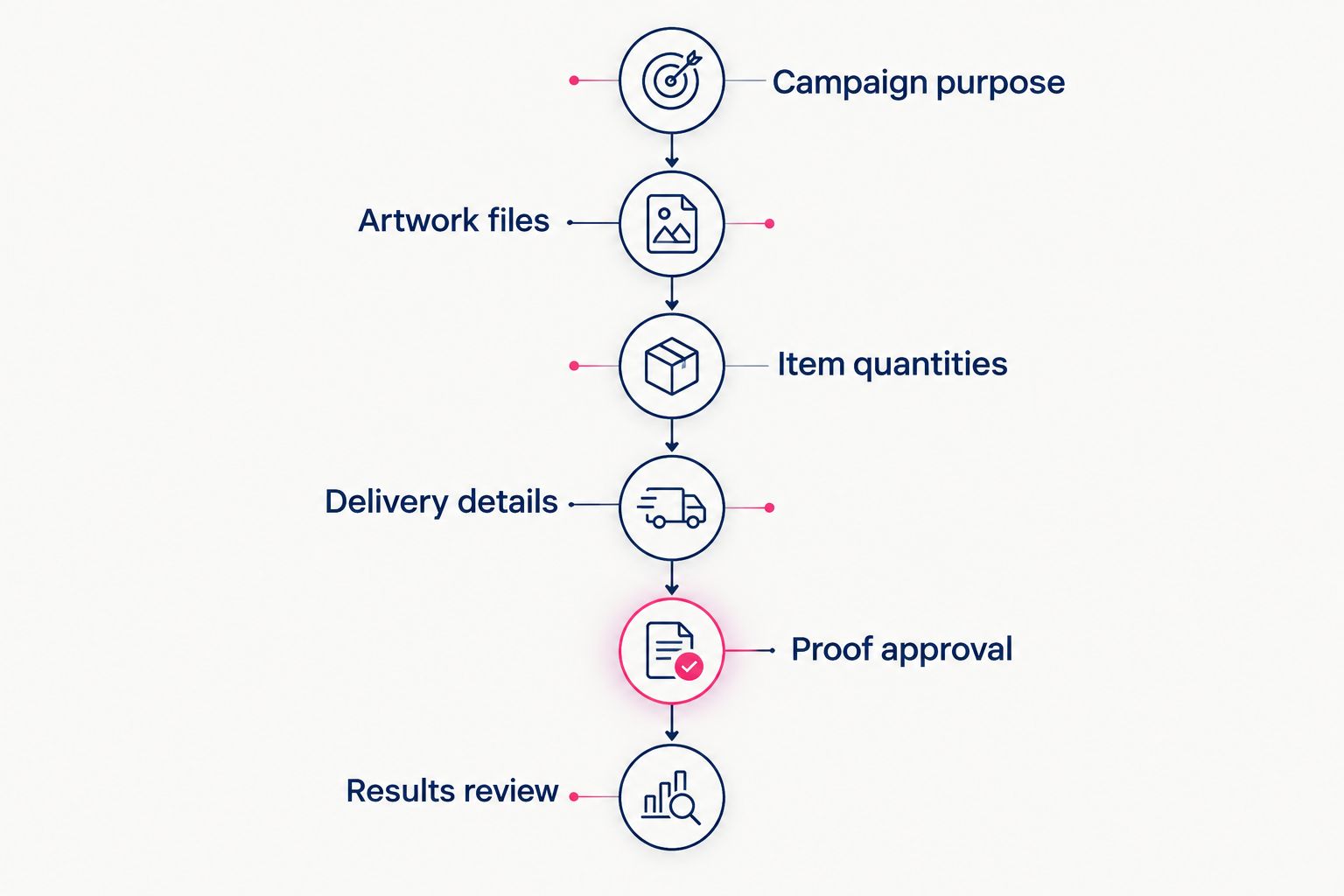
Keep the approved specifications and distribution plan together.
Compare nonprofit promotional product options for 2026
These categories are starting points for a buying brief, not confirmation of a particular supplier's catalog. Select the intended use first, then confirm the specific item, decoration, and production requirements during quoting.
| Option | Best for | Practical advantage | Key limitation |
|---|---|---|---|
| Tote bags | Event attendees carrying materials | Combines a carrying function with visible decoration | Dimensions and construction must suit the intended contents |
| Drinkware | Supporter appreciation with an everyday-use focus | Gives the item a clear use beyond the event | Material, care, packaging, and decoration need review |
| Notebooks | Training sessions and participant programs | Connects the item to a writing task | Format and paper choice must match that task |
| Volunteer apparel | Identifying an event or program team | Supports a consistent team appearance | Requires sizing, fit decisions, and organized distribution |
| Small keepsakes | Recognition tied to a specific occasion | Provides a compact commemorative item | Offers limited space for detailed messaging |
The strongest option is the one with a credible use and a manageable handoff. A compact keepsake fits recognition but does not replace useful volunteer equipment. Apparel supports team identity but adds sizing work. Compare those trade-offs before approving artwork.
Keep campaign claims separate from product claims. A bag displaying your mission does not establish an environmental benefit. A purchased item does not automatically demonstrate donor loyalty. Describe what the item does, and document any additional claim before printing it.
Common nonprofit merchandise mistakes in 2026
Ordering one item for every audience
A donor thank-you and a volunteer identifier solve different problems. Combining them into one order can leave both groups with an item that does neither job clearly. Create separate use cases before deciding whether a shared product makes sense.
Approving the logo but not the item
A proof review can focus everyone's attention on spelling and color while the underlying object gets little scrutiny. Review dimensions, materials, care information, and decoration together. Record which details the proof represents and which require separate confirmation.
Filling every available surface
A mission statement, event date, sponsor list, donation request, and logo compete for space. Choose the message that serves the product's job. Move supporting information to an accompanying card or event material when that makes the item easier to understand.
Treating the event date as the production deadline
An order needed at an event must arrive before staff can inspect, sort, and distribute it. Work backward from the handoff, not merely from the opening time. Confirm the schedule rather than assuming a general rush statement applies to merchandise.
Calling every distributed item a result
Distribution measures where inventory went. It does not establish awareness, donations, or retention. Track the intended action separately, and describe recipient feedback as feedback rather than proof of campaign impact.
Build Your Nonprofit Project Quote
Share your audience, item ideas, quantities, artwork, and required arrival date.
FAQ
What are the best promotional products for nonprofit organizations?
The best promotional products for nonprofit organizations match a specific audience and use. Consider volunteer apparel for team identification, notebooks for participant sessions, or tote bags for carrying event materials; confirm the actual item specifications before ordering.
Should nonprofits give merchandise away or sell it?
Choose based on the campaign's purpose. Appreciation gifts recognize support, while merchandise offered for sale needs a clear fundraising explanation and separate inventory tracking. Check the applicable fundraising and accounting requirements for your organization.
What should a nonprofit include in a promotional products quote request?
Include the intended use, item category, quantities, decoration locations, artwork files, delivery destination, and required arrival date. Identify any packaging, sorting, or accompanying print requirements so the proposal addresses the whole project.
Is volunteer apparel better than a general giveaway?
Volunteer apparel is better for identifying a team, while a general giveaway serves a different purpose. Apparel also requires sizing and distribution decisions, so choose it when team identification or recognition justifies that work.
Can State 48 Print help with merchandise and other campaign printing?
State 48 Print offers promotional products, branded apparel, commercial printing and mailing, signage, and other printing services. Submit the campaign requirements together and confirm the specifications, responsibilities, and schedule for each component.
Can a nonprofit get rush promotional products?
Confirm promotional product timing for the specific item and project; do not assume rush eligibility. Rush printing available on select products. Contact us to confirm turnaround times based on your project specifications.
How should nonprofits measure a merchandise campaign?
Measure distribution and the intended campaign action separately. Record items distributed, inventory remaining, recipient feedback, and relevant participation or response records without treating the merchandise as proven to have caused the outcome.
One last thing
Before your next 2026 order, decide what happens to the last unopened box. That question forces useful decisions about quantities, storage, dated artwork, and future distribution. If no one can explain where the remaining items belong, revise the plan before approving production.
Send State 48 Print a brief built around the recipient, the purpose, and the required arrival date. Include related signage or printed materials in the discussion so the quote reflects the campaign you need to run—not just the object you initially considered.